How to get rid of bruises faster: 8 steps that work for older skin
 By Margaret Hale, Reunoa EditorialLast updated
The short answer
To help a bruise fade faster, cool it with a wrapped cold pack for 10–15 minutes at a time during the first 48 hours, rest and raise the area, then switch to gentle warmth. Topical arnica at high strength and vitamin K creams have shown faster fading in small trials. Most bruises still need one to three weeks.
Key takeaways
- The first 48 hours matter most: cold, rest, gentle pressure and elevation limit how much blood leaks out [1].
- After two days, gentle warmth and light movement help your body clear the trapped blood.
- 20% arnica ointment helped bruises fade faster than placebo in a randomised trial; very diluted homeopathic arnica did not [3] [4].
- Vitamin K cream applied after a procedure reduced bruise severity in a controlled study [5].
- Older skin heals more slowly. Expect weeks, not days — and see a doctor if a bruise grows, hurts more or hasn't faded in a month.
On this page
- Step 1: Cool it in the first 48 hours
- Step 2: Rest and raise the area
- Step 3: Press gently — then leave it alone
- Step 4: Switch to warmth after two days
- Step 5: Use high-strength arnica
- Step 6: Try vitamin K cream
- Step 7: Strengthen the skin around it
- Step 8: Know what doesn't help
- How long will it take?
- Frequently asked questions
There is no way to make a bruise vanish overnight — anyone who promises that is selling something. But there is a lot you can do to make a bruise smaller, less painful and shorter-lived, especially if you start early.
Older skin needs a slightly different approach. Bruises are larger, heal more slowly and the skin around them tears more easily. In our anonymous survey of U.S. adults over 55, 45% said a typical bruise takes two to three weeks to fade, and 17% said a month or more [11]. These eight steps are the ones with the best mix of evidence and common sense.
Step 1: Cool it in the first 48 hours
Right after a knock, the broken capillaries are still leaking. Cold narrows the blood vessels and slows that leak, which can mean a smaller bruise. MedlinePlus recommends ice wrapped in a clean towel, applied for up to 15 minutes each hour [1].
- Wrap the cold pack, frozen peas or ice in a thin towel — never put ice directly on thin skin.
- Use it for 10–15 minutes, then take it off for at least an hour.
- Repeat several times on the first day and the second day.
To be honest about the evidence: research on ice for soft-tissue injury is surprisingly thin, and a systematic review found few high-quality trials and no clear "best" method [2]. Still, cold is low-risk, eases pain and is what doctors recommend.
Step 2: Rest and raise the area
Keeping a bruised arm or leg raised above the level of your heart "helps keep blood from pooling in the bruised tissue", according to MedlinePlus [1]. Prop your arm on cushions while you watch TV, or put your feet up on a stool for a shin bruise.
Step 3: Press gently — then leave it alone
Light, steady pressure with your hand over the cold pack for the first few minutes helps the leak stop sooner. After that, don't massage, poke or rub a fresh bruise. On fragile skin, firm rubbing can make the bruise bigger or tear the skin.
Step 4: Switch to warmth after two days
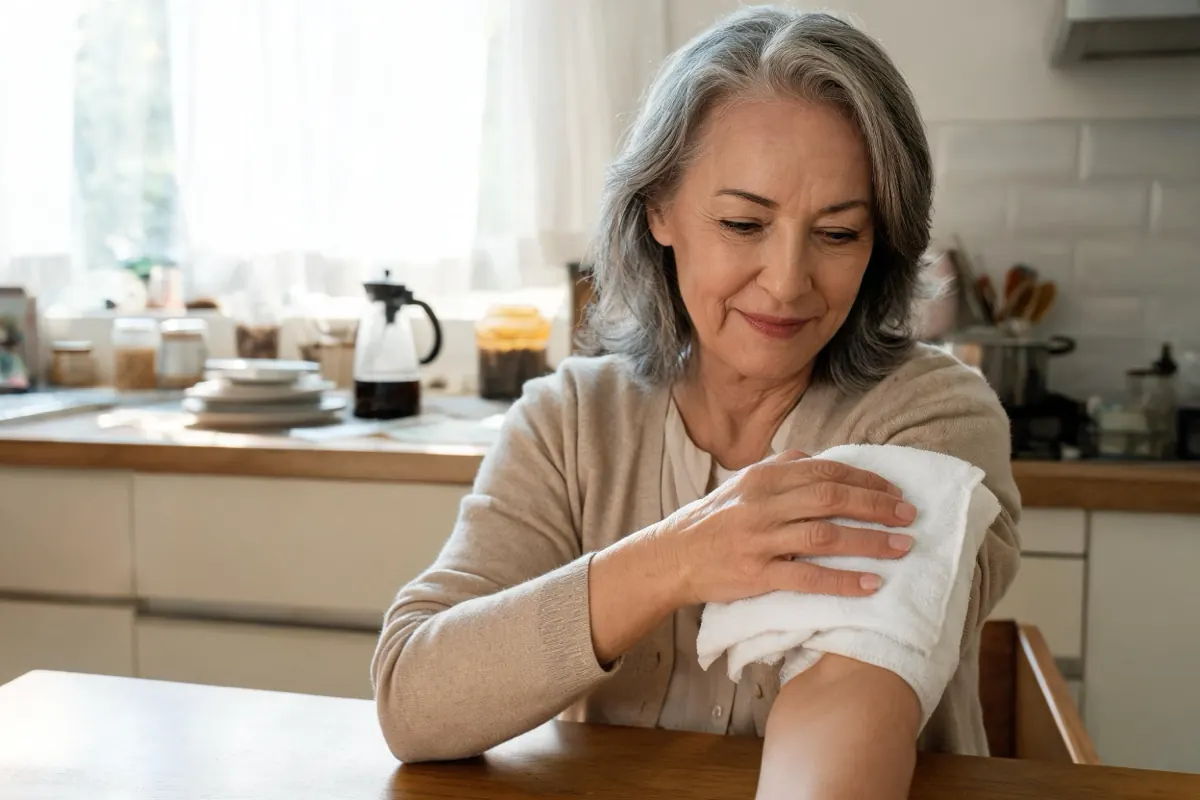
Once the bleeding has stopped — usually after about 48 hours — gentle warmth increases blood flow to the area and helps your body carry away the trapped blood. A warm (not hot) compress for 10 minutes a few times a day is enough. If your skin has reduced sensation, test the temperature with your other hand first. More in Ice or heat for a bruise? The 48-hour rule.
Step 5: Use high-strength arnica
Arnica montana is the ingredient people most often reach for — and the strength makes all the difference.
- In a rater-blinded randomised trial, 20% arnica ointment helped laser-induced bruises improve more than a placebo (white petrolatum) and more than a low-strength vitamin K–retinol cream [3].
- In contrast, homeopathic arnica (diluted to tiny amounts) showed no difference from placebo for bruising after eyelid surgery [4].
- A systematic review concluded that results overall are mixed and more research is needed [7].
The takeaway: if you use arnica, choose a product that states a meaningful concentration rather than a homeopathic "X" or "C" dilution. Most drugstore gels are homeopathic. Apply to unbroken skin only.
Step 6: Try vitamin K cream
Vitamin K plays a central role in clotting. Applied to the skin, it has been tested after cosmetic laser treatments:
- Vitamin K cream applied after laser treatment reduced bruise severity compared with placebo, especially in the first days; applied only before, it didn't help [5].
- A cream combining 1% vitamin K and 0.3% retinol made laser bruises resolve faster than no treatment [6].
These were small studies on fresh, procedure-caused bruises, not age-related bruising, so treat them as encouraging rather than proof. Learn more in our vitamin K cream guide.
Step 7: Strengthen the skin around it
A bruise heals inside your skin, but the skin around it needs care too. Thin skin dries out easily and becomes more likely to tear and bruise again. A twice-daily moisturising routine nearly halved skin tears in aged-care residents in one trial [9]. For people with recurring purple patches (senile purpura), a citrus bioflavonoid supplement reduced new lesions by half over six weeks in a placebo-controlled study [8] — talk to your pharmacist before adding any supplement if you take other medicines.
Step 8: Know what doesn't help
- Very hot water or heat in the first two days — it can increase bleeding.
- Massaging a fresh bruise — risks more damage to fragile vessels.
- Ibuprofen or aspirin for bruise pain — they can make bleeding worse. Ask your pharmacist about acetaminophen (paracetamol) instead.
- Raw meat, vinegar, toothpaste — popular myths with no evidence.
- Stopping a blood thinner — never do this because of bruising. See bruising on blood thinners.
How long will it take?
Bruises change colour as your body breaks down the blood: from red-purple to blue, then green, yellow and finally brown. Visual dating of bruises is unreliable, but yellow indicates a bruise is not recent [10]. After 60, most bruises fade within two to four weeks. Some leave a brown stain that lasts longer — that's hemosiderin staining. See bruise color stages and how long does a bruise last after 60?
Frequently asked questions
What is the fastest way to get rid of a bruise?
Cool it with a wrapped cold pack for 10–15 minutes several times in the first 48 hours, rest and raise the area, then switch to gentle warmth. High-strength topical arnica and vitamin K cream have helped bruises fade faster in small trials. Most bruises still take one to three weeks.
Can you get rid of a bruise in 24 hours?
No. Your body needs time to break down and clear the trapped blood. What you can do in the first 24 hours — cold, rest, elevation and gentle pressure — makes the bruise smaller and shorter-lived, but it will still be visible for days.
Does arnica really work on bruises?
High-strength arnica (20% ointment) helped bruises fade faster than placebo in a randomised trial. Highly diluted homeopathic arnica did not work better than placebo in a separate trial. The strength on the label matters.
Does toothpaste or vinegar help bruises?
There is no scientific evidence that toothpaste, vinegar, potatoes or raw meat speed bruise healing. Toothpaste can irritate thin skin. Stick to cold, rest, elevation, warmth after 48 hours and researched topical ingredients.
Why do my bruises take so long to heal?
Older skin has slower circulation and repair, and bruises tend to be larger because vessels are more fragile. Blood thinners make more blood leak before the vessel seals. Bruises lasting more than a month, or that keep appearing without injury, should be checked by a doctor.
Should I massage a bruise?
Not in the first two days — that can make the bleeding worse, and on thin skin it can cause a tear. After 48 hours, very gentle strokes around the edge of the bruise while applying cream are fine if they don't hurt.
Sources
- Bruise — MedlinePlus Medical Encyclopedia.
- Bleakley C, et al. The use of ice in the treatment of acute soft-tissue injury: a systematic review of randomized controlled trials. American Journal of Sports Medicine, 2004. PubMed 14754753
- Leu S, et al. Accelerated resolution of laser-induced bruising with topical 20% arnica: a rater-blinded randomized controlled trial. British Journal of Dermatology, 2010. PubMed 20412090
- Kotlus BS, et al. Evaluation of homeopathic Arnica montana for ecchymosis after upper blepharoplasty: a placebo-controlled, randomized, double-blind study. Ophthalmic Plastic and Reconstructive Surgery, 2010. PubMed 20683279
- Shah NS, et al. The effects of topical vitamin K on bruising after laser treatment. Journal of the American Academy of Dermatology, 2002. PubMed 12140470
- Lou WW, et al. Effects of topical vitamin K and retinol on laser-induced purpura on nonlesional skin. Dermatologic Surgery, 1999. PubMed 10594627
- Ho D, et al. Is There a Role for Arnica and Bromelain in Prevention of Post-Procedure Ecchymosis or Edema? A Systematic Review of the Literature. Dermatologic Surgery, 2016. PubMed 27035499
- Berlin JM, et al. A randomized, placebo-controlled, double-blind study to evaluate the efficacy of a citrus bioflavanoid blend in the treatment of senile purpura. Journal of Drugs in Dermatology, 2011. PubMed 21720653
- Carville K, et al. The effectiveness of a twice-daily skin-moisturising regimen for reducing the incidence of skin tears. International Wound Journal, 2014. PubMed 25040325
- Langlois NE The science behind the quest to determine the age of bruises — a review of the English language literature. Forensic Science, Medicine and Pathology, 2007. PubMed 25869263
- Fragile Skin Report 2027 — aggregated, anonymous answers from the Reunoa skin quiz — Reunoa Editorial (learn.reunoa.com).
General information, not medical advice. Written by the Reunoa editorial team; Reunoa makes Bruise Defense & Repair Serum. See our editorial policy for how we pick sources and keep product mentions fair.