Bruising on blood thinners: what's normal, what's not, and what helps
 By Margaret Hale, Reunoa EditorialLast updated
The short answer
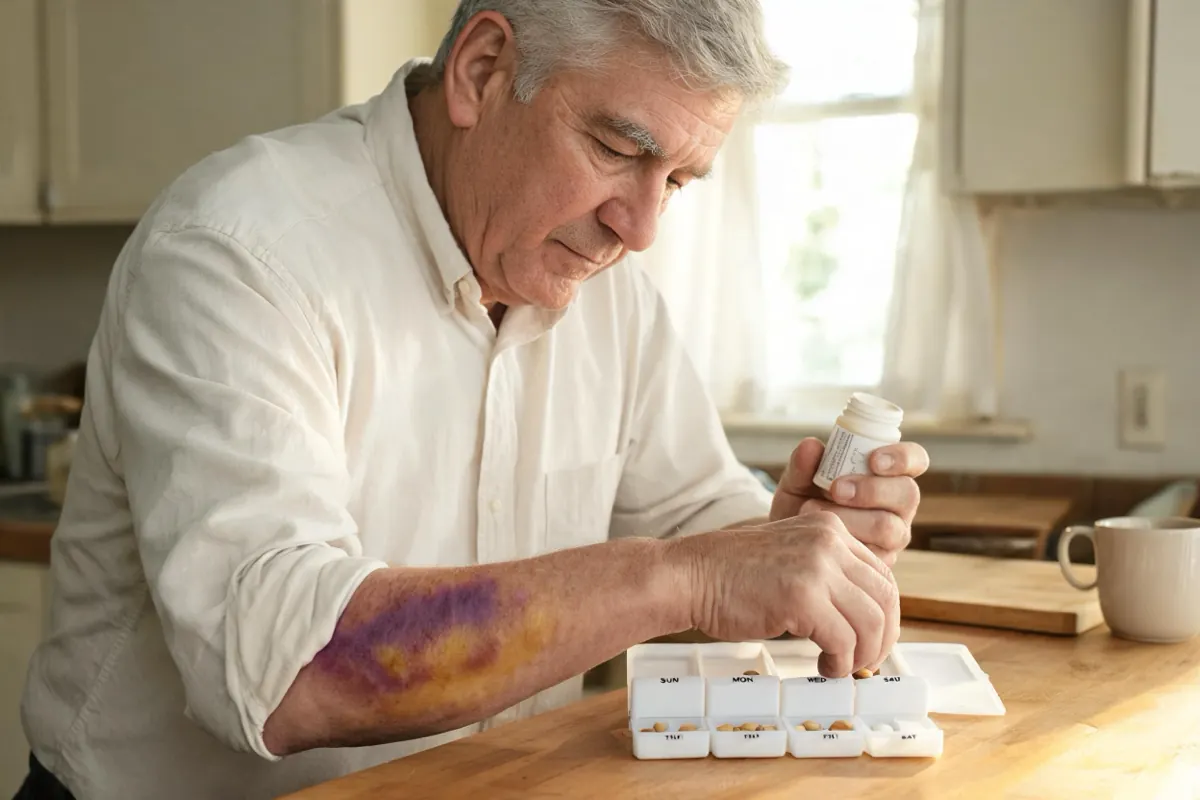
Bruising more easily is the most common side effect of blood thinners such as apixaban (Eliquis), rivaroxaban (Xarelto) and warfarin, because blood takes longer to clot after a small knock. Flat bruises from minor bumps are usually expected. Large, painful or unexplained bruises, or any other bleeding, should be reported to your doctor. Never stop the medicine on your own.
Key takeaways
- Easy bruising is an expected side effect of anticoagulants and antiplatelet medicines — it means the medicine is working, not that it is harming you [1].
- Never stop, skip or halve a blood thinner because of bruises. Stopping suddenly raises the risk of stroke and clots.
- Warning signs include very large or swelling bruises, bruises without any knock, blood in urine or stools, black stools, coughing or vomiting blood and severe headache [2].
- On older, thinner skin, bruises on blood thinners mostly appear on the forearms and hands. Protecting and strengthening that skin is the part you control.
- Topical products work on the skin, not in the blood. If you take warfarin, tell your anticoagulation clinic about any new product as a simple precaution.
On this page
If you take a blood thinner, you have probably noticed new purple patches on your arms and wondered whether you should worry. You are far from alone: in our anonymous survey of U.S. adults over 55, 45% said they take a daily blood thinner or low-dose aspirin, and among respondents aged 75 and older it was just over half [12].
This guide explains why blood thinners cause bruising, how to tell an ordinary bruise from a warning sign, and what you can safely do for your skin. One rule runs through all of it: your medicine stays exactly as prescribed.
Why blood thinners cause bruising
Blood thinners don't actually make blood thinner. They slow down the chain of steps that forms a clot. There are two main groups [1]:
- Anticoagulants — warfarin, apixaban (Eliquis), rivaroxaban (Xarelto), dabigatran (Pradaxa) and edoxaban (Savaysa). They act on clotting factors in the blood.
- Antiplatelet medicines — low-dose aspirin, clopidogrel (Plavix), prasugrel and ticagrelor. They make platelets less sticky.
When a small capillary breaks after a knock, platelets and clotting factors normally seal it within seconds. On a blood thinner that takes a little longer, so more blood leaks into the tissue before the leak stops. The result is a bigger, darker bruise — or a bruise from a bump you never noticed. The official drug information for warfarin, apixaban, rivaroxaban and clopidogrel all lists easy bruising and bleeding as a side effect [3] [4] [5] [6].
Why it's worse after 60
Blood thinners are prescribed mostly to older adults — for atrial fibrillation, after a clot, or after a stent or heart valve. At the same age, skin is naturally thinner, has less fat padding and has more fragile blood vessels [9]. So two things meet: capillaries that break more easily, and blood that clots more slowly. That is why forearms and the backs of the hands are where most people on blood thinners see marks.
Eliquis, Xarelto, warfarin, aspirin: is one worse for bruising?
People often ask whether switching medicine would mean fewer bruises. The honest answer: the choice of blood thinner is a medical decision based on your heart, kidneys, other medicines and stroke risk — not on bruising.
What large studies show about serious bleeding:
| Medicine type | Examples | What research shows |
|---|---|---|
| Newer anticoagulants (DOACs) | Apixaban, rivaroxaban, dabigatran, edoxaban | In a pooled analysis of 71,683 patients with atrial fibrillation, standard-dose DOACs had about half the rate of bleeding in the brain compared with warfarin [7] |
| Warfarin | Coumadin, Jantoven | Needs regular INR blood tests; bleeding risk rises when INR is too high [3] |
| Antiplatelets | Low-dose aspirin, clopidogrel | Aspirin raised major bleeding versus placebo in healthy older adults in the ASPREE trial [8] |
| Combination | Anticoagulant + aspirin or clopidogrel | Bleeding and bruising are more likely when two are combined — usually only for a set period after a stent |
None of this means you should change anything yourself. If bruising is bothering you, bring it up at your next appointment. Your doctor can check your dose, kidney function, INR (if on warfarin) and other medicines.
Normal bruising vs. warning signs
Ordinary, expected bruising on blood thinners usually looks like this: flat, purple or red-purple patches on the forearms, hands or shins; often after a minor bump; not painful; fading over two to three weeks through green, yellow and brown.
What you can safely do
You can't change the way your medicine works — and you shouldn't. But you can do a lot for the skin.
Prevent the bumps
Most bruises on blood thinners come from small everyday contacts: a cupboard door, a car door frame, a dog's claws, a tight blood-pressure cuff. Long, light sleeves when gardening, padded edges on furniture, good lighting at night and removing trip hazards make a real difference. Our 12 everyday habits list has more ideas.
Strengthen the skin barrier
Dry skin is less flexible and splits more easily. In aged-care residents, a simple twice-daily moisturising routine cut skin tears by almost half [10]. Choose a fragrance-free product with barrier lipids such as ceramides and apply it morning and night to forearms, hands and shins.
After a knock: the first 48 hours
Apply a cold pack wrapped in a cloth for 10–15 minutes, rest the area and raise it if you can. Firm, gentle pressure for a few minutes helps slow the leak. Then switch to gentle warmth after two days. See ice or heat for a bruise?
Topical ingredients
Topical products sit on and in the skin. They don't change how your blood clots. High-concentration topical arnica has been tested on bruises: in a randomised trial, 20% arnica ointment helped laser-induced bruises fade faster than a placebo [11]. Vitamin K creams and ceramide moisturisers are also popular. Read more in our ingredient guides.
Review supplements
Fish oil, vitamin E, ginkgo, garlic tablets, turmeric and some pain relievers (such as ibuprofen and naproxen) can add to a blood thinner's effect. Ask your pharmacist to check everything you take — including over-the-counter products.
Frequently asked questions
Is it normal to bruise easily on Eliquis?
Yes. Easy bruising is one of the most common side effects of apixaban (Eliquis) and of other blood thinners. Small, flat bruises after minor bumps are usually expected. Tell your doctor about large, painful or unexplained bruises or any other bleeding, and never stop the medicine on your own.
Should I stop my blood thinner if I bruise a lot?
No. Stopping a blood thinner without medical advice can raise your risk of stroke or a dangerous clot within days. Speak to your doctor or pharmacist about the bruising instead. They can review your dose and other medicines.
Do bruises take longer to heal on blood thinners?
Often, yes. Because more blood leaks out before the vessel seals, bruises tend to be larger and can take longer to fade. Most still clear in two to four weeks. A bruise that is growing, very painful or not fading after a month should be checked.
Can I use arnica if I take blood thinners?
Arnica applied to unbroken skin works locally on the bruise. It should not be taken by mouth unless it is a highly diluted homeopathic product, and it should not be put on open wounds. If you are unsure, ask your pharmacist, and stop using any product that irritates your skin.
Does vitamin K cream interfere with warfarin?
Vitamin K applied to skin is a different route from vitamin K in food or tablets, which is what affects warfarin. As a precaution, tell your anticoagulation clinic before starting a vitamin K cream and keep your regular INR checks. Eliquis and Xarelto do not work through vitamin K.
Which blood thinner causes the least bruising?
There is no single answer. Large studies show newer anticoagulants cause less bleeding in the brain than warfarin, but bruising varies from person to person. The right medicine depends on your heart, kidneys and other drugs, so any switch is a decision for your doctor.
Why do I get purple patches on my arms on blood thinners?
The flat purple patches on forearms and hands are usually senile (actinic) purpura: fragile, sun-aged blood vessels that leak after tiny knocks, made more visible by slower clotting. They are harmless in themselves but can be distressing. Learn more in our senile purpura guide.
More in this guide
- Does daily aspirin cause bruising?
Yes — daily low-dose aspirin makes platelets less sticky, so bruises form more easily and last longer, especially on thin older skin. What's normal, warning signs, and why you shouldn't stop it on your own.
Sources
- Blood Thinners — MedlinePlus (U.S. National Library of Medicine).
- Anticoagulant medicines — side effects — NHS (UK National Health Service).
- Warfarin — Drug Information — MedlinePlus.
- Apixaban — Drug Information — MedlinePlus.
- Rivaroxaban — Drug Information — MedlinePlus.
- Clopidogrel — Drug Information — MedlinePlus.
- Carnicelli AP, et al. Direct Oral Anticoagulants Versus Warfarin in Patients With Atrial Fibrillation: Patient-Level Network Meta-Analyses of Randomized Clinical Trials. Circulation, 2022. PubMed 34985309
- McNeil JJ, et al. Effect of Aspirin on Cardiovascular Events and Bleeding in the Healthy Elderly (ASPREE). New England Journal of Medicine, 2018. PubMed 30221597
- Aging changes in skin — MedlinePlus Medical Encyclopedia.
- Carville K, et al. The effectiveness of a twice-daily skin-moisturising regimen for reducing the incidence of skin tears. International Wound Journal, 2014. PubMed 25040325
- Leu S, et al. Accelerated resolution of laser-induced bruising with topical 20% arnica: a rater-blinded randomized controlled trial. British Journal of Dermatology, 2010. PubMed 20412090
- Fragile Skin Report 2027 — aggregated, anonymous answers from the Reunoa skin quiz — Reunoa Editorial (learn.reunoa.com).
General information, not medical advice. Written by the Reunoa editorial team; Reunoa makes Bruise Defense & Repair Serum. See our editorial policy for how we pick sources and keep product mentions fair.