Senile purpura: the complete guide to purple patches on aging skin
 By Margaret Hale, Reunoa EditorialLast updated
The short answer
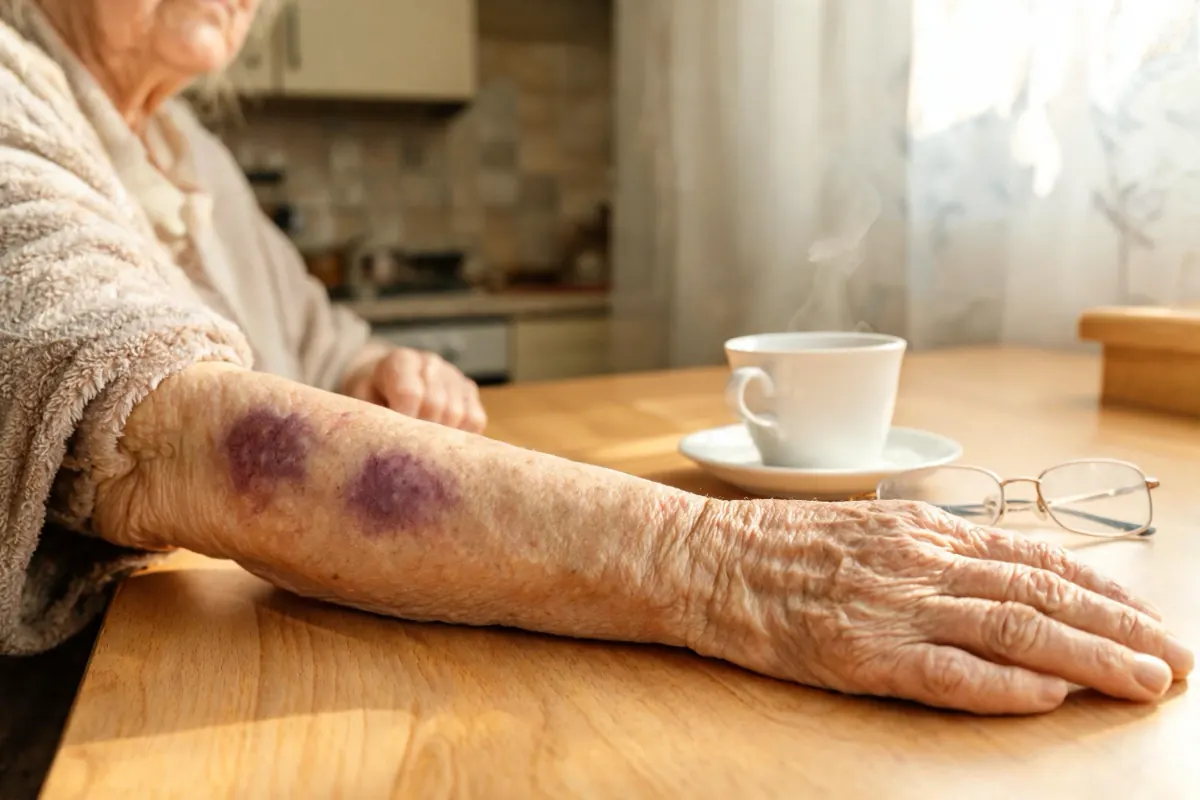
Senile purpura — also called actinic or Bateman purpura — is a common, harmless condition in which flat, dark-purple patches 1–4 cm wide appear on the forearms and backs of the hands after minor knocks. It is caused by thin, sun-damaged skin and fragile blood vessels, affects over 10% of people over 50, and each patch fades in one to three weeks.
Key takeaways
- Senile purpura is benign: it is not a blood disorder and isn't linked to disease in the body [1].
- It affects more than 1 in 10 people over 50, men and women equally; sun damage, steroids and blood thinners raise the risk [1].
- Patches are dark purple, flat, sharply outlined and mostly on forearms and hands. Unlike ordinary bruises, they often skip the green-yellow stage.
- They can leave brown stains (hemosiderin) and mark skin that is prone to tearing.
- Sun protection, moisturising, protecting the arms and some topical and oral options have evidence of benefit.
On this page
For many people the first sign is a dark purple patch on the forearm that looks like a bad bruise — but you can't remember any bump. Then another appears. Then the backs of your hands. If that sounds familiar, you may have senile purpura, one of the most common skin conditions after 60.
The name sounds alarming. "Senile" here just means "related to age" — it has nothing to do with memory. Doctors increasingly use the friendlier terms actinic purpura (from sun damage) or Bateman purpura, after the British dermatologist Thomas Bateman, who described it in 1818 [1].
In our anonymous online skin quiz, 87% of the 3,920 U.S. respondents who were shown a photo of typical forearm patches answered "Yes — that's my skin", and 74% of respondents said their marks appear mainly on the forearms and backs of the hands [11]. (Our respondents found the quiz through ads for a bruise serum, so they are not a random sample — see the report's methods.)
What senile purpura looks like
DermNet, the dermatology reference run by New Zealand dermatologists, describes the patches as [1]:
| Feature | Senile purpura | Ordinary bruise |
|---|---|---|
| Colour | Dark purple to red-purple | Red-purple, then blue, green, yellow, brown |
| Shape | Irregular, sharp edges, 1–4 cm | Rounder, blurry edges |
| Feel | Flat, not raised, usually painless | Often tender or swollen |
| Location | Forearms (outer side), backs of hands; rarely neck or face | Anywhere you bump |
| Cause | Very minor knock or friction — often unnoticed | A noticeable injury |
| Colour change | Often stays purple, then fades | Goes through the colour stages |
| How long | Up to 3 weeks; may leave a brown mark | 1–3 weeks |
The skin around the patches is usually thin, shiny, a bit translucent and marked by sun damage — age spots, fine wrinkling, sometimes small white star-shaped scars where earlier patches or tears have healed.
Why it happens
Three structural changes come together [1] [2]:
- Thinner skin with less collagen. With age and sun exposure, the dermis — the supporting middle layer — becomes thin, and its collagen is reduced and replaced by abnormal elastic fibres.
- Unsupported blood vessels. The vessel walls themselves are normal, but without firm collagen around them, the small vessels near the surface tear when the skin is pushed or twisted even slightly.
- Slow clean-up. Older skin clears leaked blood more slowly, so patches linger, and the iron left behind can stain the skin brown.
Swiss dermatologists group thin, bruise-prone, tear-prone skin under the term dermatoporosis — likening it to osteoporosis of the skin [4]. Our article What causes senile purpura? The 3 structural reasons goes deeper.
Who gets it
Senile purpura affects over 10% of people over 50 and is equally common in men and women [1]. You are more likely to get it if you:
- have spent a lot of time in the sun (gardeners, golfers, sailors, outdoor workers)
- have fair skin
- take blood thinners or antiplatelet medicines such as aspirin or clopidogrel
- use steroid tablets, steroid inhalers or strong steroid creams over long periods
The medicines don't cause the fragile skin, but they make each leak bigger and more visible. If you take one, keep taking it as prescribed — see bruising on blood thinners.
Is senile purpura dangerous?
No. DermNet states that senile purpura is benign and unrelated to any disease in the body or blood disorder; blood tests are rarely needed and are typically normal [1].
It does matter for two reasons: the skin it appears on is the same skin that tears easily, and many people find the marks upsetting. In our survey, "how the marks look" was the top concern (54%), and 41% said they wear long sleeves even on warm days to hide them [11].
Treatment and what helps
There's no cure that makes old skin young again — but there is more you can do than "live with it".
1. Protect from the sun
DermNet's main management advice is sun protection — sunscreen and sun-protective clothing — to prevent further photodamage [1]. UV light breaks down collagen in the dermis [9], so protecting forearms and hands slows the process that causes the purpura in the first place.
2. Moisturise twice a day
Thin skin dries out quickly. In a trial in aged-care homes, a twice-daily moisturiser nearly halved skin tears compared with usual care [8]. Use a fragrance-free product on forearms and hands morning and night.
3. Topical treatments
A review in the Journal of Clinical and Aesthetic Dermatology discusses a topical approach for actinic purpura combining ingredients that support skin thickness (retinol, alpha-hydroxy acids), circulation (arnica), the skin barrier (ceramides, niacinamide) and vitamin K (phytonadione) [3]. Note that this review was funded by the maker of a purpura cream. Individually:
- Arnica: 20% arnica ointment helped bruises fade faster than placebo in a randomised trial [6].
- Vitamin K: a vitamin K cream reduced bruise severity after laser treatment [7].
- Ceramides: replenish the lipids in the outer skin barrier, which tends to weaken with age.
- Retinoids: can thicken aged skin over months, but can irritate thin skin — see retinol for thin skin.
Compare products in our best creams for senile purpura guide.
4. Citrus bioflavonoids (oral)
In a randomised, placebo-controlled, double-blind study, a citrus bioflavonoid supplement reduced new purpura lesions by 50% after six weeks, with no side effects reported [5]. Check with your pharmacist first if you take other medicines.
5. Protect your arms
Light long sleeves, padded furniture edges and care with car doors, pets and grab rails reduce the minor friction that sets off new patches. Our everyday habits list has practical ideas.
Frequently asked questions
What is senile purpura?
Senile purpura, also called actinic or Bateman purpura, is a common and harmless skin condition of older adults. Flat, dark-purple patches appear on the forearms and backs of the hands after very minor knocks because sun-aged, thin skin no longer supports its small blood vessels.
Is senile purpura serious?
No. It is benign and not linked to blood disorders or disease in the body. It does signal thin, fragile skin that tears more easily, and it can be upsetting to look at. See a doctor if patches appear in unusual places or with other bleeding.
How long does senile purpura last?
Each patch usually fades within one to three weeks, though some leave a brown stain from iron in the leaked blood. New patches tend to keep appearing as long as the skin stays thin and fragile.
What is the best treatment for senile purpura?
Sun protection and twice-daily moisturising are the foundation. Topical products with arnica, vitamin K, ceramides and retinoids have some supporting studies, and an oral citrus bioflavonoid blend halved new lesions in one placebo-controlled trial.
Is senile purpura caused by blood thinners?
Not directly. It is caused by thin, sun-damaged skin. Blood thinners and aspirin make each leak bigger and more visible, so people on them often notice it more. Never stop a blood thinner because of purpura.
What is the difference between senile purpura and a bruise?
Senile purpura appears after very minor or unnoticed contact, is flat, dark purple with sharp edges, usually painless, and often doesn't go through the green-yellow stages. An ordinary bruise follows a noticeable injury, is often tender and changes colour as it heals.
Can senile purpura be prevented?
You can reduce new patches by protecting forearms from the sun and bumps, moisturising twice daily and keeping skin strong with barrier-supporting ingredients. Underlying skin thinning can't be fully reversed, so prevention is ongoing.
More in this guide
- What causes senile purpura? The 3 structural reasons
Senile purpura is caused by three structural changes in aging, sun-damaged skin: a thin dermis with less collagen, unsupported small blood vessels, and slow clearing of leaked blood. Plus the medicines that make it more visible.
Sources
- Senile purpura — DermNet (New Zealand).
- Aging changes in skin — MedlinePlus Medical Encyclopedia.
- Ceilley RI Treatment of Actinic Purpura. Journal of Clinical and Aesthetic Dermatology, 2017. PubMed 28979656
- Kaya G, Saurat JH Dermatoporosis: a chronic cutaneous insufficiency/fragility syndrome. Dermatology, 2007. PubMed 17911985
- Berlin JM, et al. A randomized, placebo-controlled, double-blind study to evaluate the efficacy of a citrus bioflavanoid blend in the treatment of senile purpura. Journal of Drugs in Dermatology, 2011. PubMed 21720653
- Leu S, et al. Accelerated resolution of laser-induced bruising with topical 20% arnica: a rater-blinded randomized controlled trial. British Journal of Dermatology, 2010. PubMed 20412090
- Shah NS, et al. The effects of topical vitamin K on bruising after laser treatment. Journal of the American Academy of Dermatology, 2002. PubMed 12140470
- Carville K, et al. The effectiveness of a twice-daily skin-moisturising regimen for reducing the incidence of skin tears. International Wound Journal, 2014. PubMed 25040325
- Rittié L, Fisher GJ Natural and sun-induced aging of human skin. Cold Spring Harbor Perspectives in Medicine, 2015. PubMed 25561721
- Bleeding into the skin — MedlinePlus Medical Encyclopedia (U.S. National Library of Medicine).
- Fragile Skin Report 2027 — aggregated, anonymous answers from the Reunoa skin quiz — Reunoa Editorial (learn.reunoa.com).
General information, not medical advice. Written by the Reunoa editorial team; Reunoa makes Bruise Defense & Repair Serum. See our editorial policy for how we pick sources and keep product mentions fair.