Unexplained bruising in an elderly parent: what's normal and what isn't
 By Margaret Hale, Reunoa EditorialLast updated
The short answer
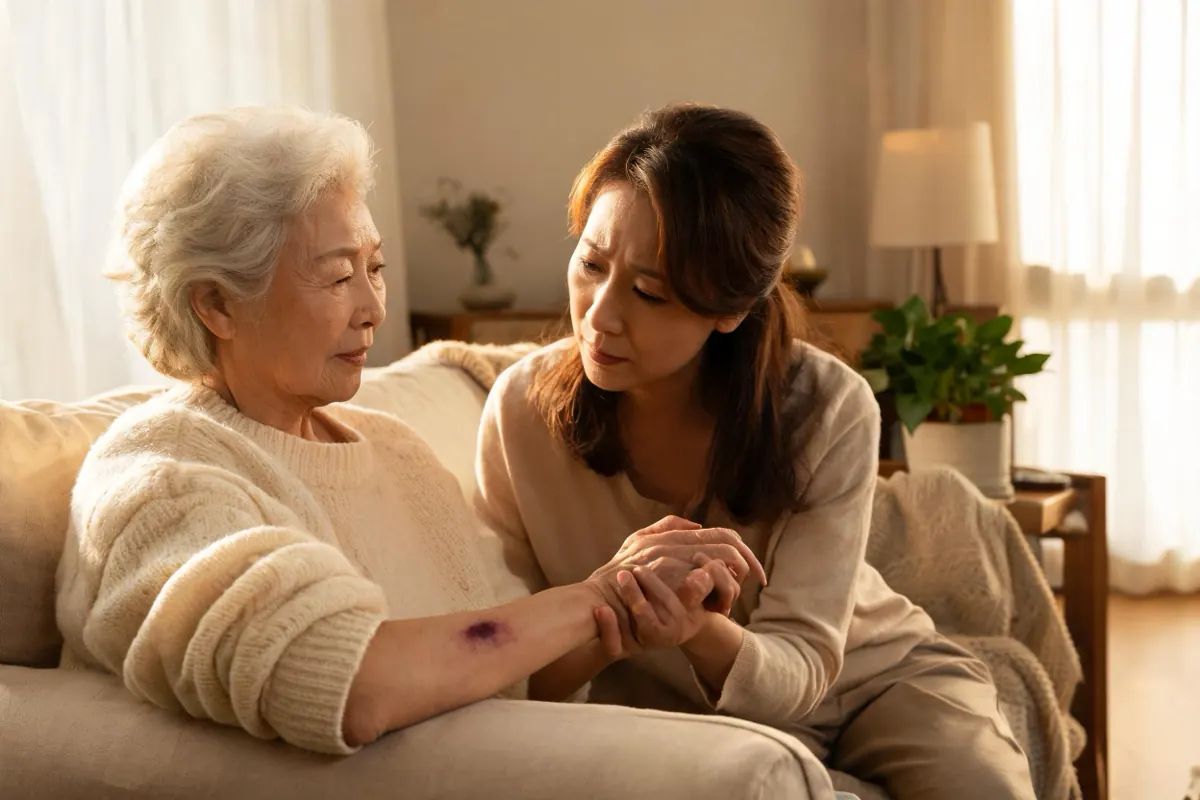
Most unexplained bruises in older parents are on the forearms, hands and shins and come from small knocks they don't remember, made worse by thin skin and blood thinners. Bruises on the face, neck, back, chest or outer right arm, bruises larger than 5 cm, or bruises with other bleeding deserve a medical check — and, rarely, can be a sign of mistreatment.
Key takeaways
- In a study of older adults, nearly 90% of accidental bruises were on the arms and legs; none were on the neck, ears, genitals, buttocks or soles [1].
- Many older adults can't recall the cause of accidental bruises on their limbs — that alone isn't alarming [1].
- Bruises from physical abuse were more often large (over 5 cm) and on the face, outer right arm or back/torso [2].
- Colour can't reliably tell a bruise's age — some were yellow within 24 hours [1].
- Blood thinners, aspirin, low platelets, liver disease and vitamin deficiencies can all cause easy bruising [3].
On this page
You notice a new bruise on your father's arm, and he shrugs: "No idea where that came from." For most families this is the start of a quiet worry. The good news is that research on older adults gives us a clear picture of what accidental bruising usually looks like — and what doesn't fit.
What accidental bruising usually looks like
The best data comes from a study that followed older adults and documented every new bruise [1]:
- Nearly 90% were on the arms and legs. Forearms, hands and shins are where most everyday bumps happen.
- None were on the neck, ears, genitals, buttocks or soles of the feet.
- People often didn't know the cause of bruises on their limbs; they were more likely to remember the cause of bruises on the trunk.
- People on medicines that affect clotting, and those who needed more help with daily activities, were more likely to have several bruises at once.
So a parent with thin skin who has a few bruises on the forearms and shins and can't remember bumping into anything is — most of the time — showing a very common pattern. Senile purpura (flat, dark-purple patches on sun-aged forearms) fits here too; see our senile purpura guide.
Don't try to "date" a bruise by colour
Many people think yellow means old. In the same study, some bruises were mostly yellow within the first 24 hours [1]. Colour depends on depth, skin and blood flow, so you can't reliably say when a bruise happened from its colour alone. More: bruise color stages.
Red flags worth a closer look
| Look out for | Why |
|---|---|
| Bruises on the face, neck, ears, chest, back or buttocks | Uncommon sites for everyday accidental bumps [1] |
| Bruises on the outer right arm, very large (over 5 cm) | Pattern more often seen in physical abuse [2] |
| Shapes — finger marks, a hand, a belt, a loop | Suggest grabbing or striking |
| Bruises on both upper arms | Can come from being gripped |
| Explanations that change or don't fit | Ask gently, write it down |
| Bruises plus nosebleeds, bleeding gums, blood in urine or stool, tiredness, weight loss | Possible medical cause [4] |
| Bruising after a fall, especially a head knock on blood thinners | Needs urgent assessment |
Medical causes your parent's doctor may check
Easy or unexplained bruising can come from [3] [4]:
- Medicines: blood thinners, aspirin, clopidogrel, some antidepressants, steroids, certain supplements (fish oil, ginkgo, vitamin E). Don't stop any of them on your own — bring a list to the appointment. See bruising on blood thinners.
- Thin, sun-damaged skin and senile purpura [8].
- Low platelets or clotting problems.
- Liver or kidney disease.
- Vitamin deficiencies, especially vitamin C or K in people who eat poorly. See what vitamin deficiency causes bruising.
- Falls — repeated bruises can be the first sign that someone is falling and not saying so.
A doctor will usually ask about medicines and falls, look at the bruises and may order simple blood tests such as a blood count and clotting tests.
When bruises might mean mistreatment
Most families never face this, but it's important to know the signs. Bruises from physical elder abuse in one study were more often large and on the face, the outer right arm or the back and torso, and abused older adults more often knew how they got them [2]. Other warning signs include fear of a particular person, withdrawal, poor hygiene, missing money or medication, and a carer who won't let you speak to your parent alone [6].
If something doesn't feel right:
- Talk to your parent alone, calmly and without leading questions.
- Take dated photos and notes of what you see.
- Speak to the doctor — they can document injuries.
- Contact Adult Protective Services in your state. The Eldercare Locator (1-800-677-1116) can connect you with local services [7].
- If someone is in immediate danger, call 911.
How to help day to day
- Keep a simple bruise diary for two weeks: date, place, size, possible cause.
- Help with a safer home: lighting, clear paths, padded corners.
- Support twice-daily moisturizing and long sleeves for fragile skin.
- Ask the doctor or pharmacist for a medication review once a year.
Frequently asked questions
Is it normal for elderly people to have unexplained bruises?
Yes, on the arms, hands and legs. Older adults often don't remember the minor bump that caused a bruise, especially with thin skin or blood thinners. Bruises elsewhere, or very large ones, deserve a check.
What bruises on an elderly person are concerning?
Bruises on the face, neck, ears, chest, back or buttocks, bruises in shapes like fingers or a hand, bruises larger than 5 cm on the outer arm, and bruising with other bleeding or tiredness.
Can you tell how old a bruise is by its color?
Not reliably. In a study of older adults, some bruises turned yellow within 24 hours. Color depends on depth, location and skin.
What blood tests check for easy bruising?
Usually a full blood count (including platelets) and clotting tests. Doctors may also check liver and kidney function and sometimes vitamin levels.
Who do I call if I suspect elder abuse?
Adult Protective Services in your state. The Eldercare Locator (1-800-677-1116) can connect you. If someone is in immediate danger, call 911.
Sources
- Mosqueda L, Burnight K, Liao S The life cycle of bruises in older adults. Journal of the American Geriatrics Society, 2005. PubMed 16078959
- Wiglesworth A, et al. Bruising as a marker of physical elder abuse. Journal of the American Geriatrics Society, 2009. PubMed 19558476
- Ballas M, Kraut EH Bleeding and bruising: a diagnostic work-up. American Family Physician, 2008. PubMed 18481559
- Bleeding into the skin — MedlinePlus Medical Encyclopedia (U.S. National Library of Medicine).
- Blood Thinners — MedlinePlus (U.S. National Library of Medicine).
- Elder Abuse — MedlinePlus.
- Eldercare Locator (U.S. Administration for Community Living) — 1-800-677-1116 — ACL.
- Aging changes in skin — MedlinePlus Medical Encyclopedia.
General information, not medical advice. Written by the Reunoa editorial team; Reunoa makes Bruise Defense & Repair Serum. See our editorial policy for how we pick sources and keep product mentions fair.