The best creams for senile purpura in 2027, ingredient by ingredient
 By Margaret Hale, Reunoa EditorialLast updated
The short answer
The best cream for senile purpura combines ingredients that help existing patches fade (high-strength arnica, vitamin K) with ingredients that strengthen thin skin (ceramides, and retinoids or AHAs if tolerated), used twice daily with sun protection. No cream cures it, but a consistent routine can make patches less frequent and less noticeable. An oral citrus bioflavonoid blend also has trial evidence.
Key takeaways
- Senile purpura comes from thin, sun-damaged skin, so the best products work on both the patches and the skin itself [1].
- Fading: 20% arnica [2] and vitamin K applied after bruising [3] have trial support.
- Strengthening: retinol increased skin matrix on elderly arms [4]; AHAs thickened photoaged skin [5]; moisturising cut skin tears [6].
- Oral citrus bioflavonoids halved new purpura lesions in six weeks in a placebo-controlled trial [7].
- We make one of the products listed; we compare published ingredients only.
On this page
- The ingredients, ranked by evidence
- 1. Reunoa Bruise Defense & Repair Serum — best for fragile skin that reacts easily
- 2. DerMend Moisturizing Bruise Formula — best all-in-one if you tolerate retinol
- 3. Skintensive Bruise Cream — best fragrance-free option with vitamin K2
- 4. A plain ceramide moisturiser + sunscreen — best budget foundation
- 5. Oral citrus bioflavonoids — best add-on, with your doctor's OK
- How to build a routine
- Frequently asked questions
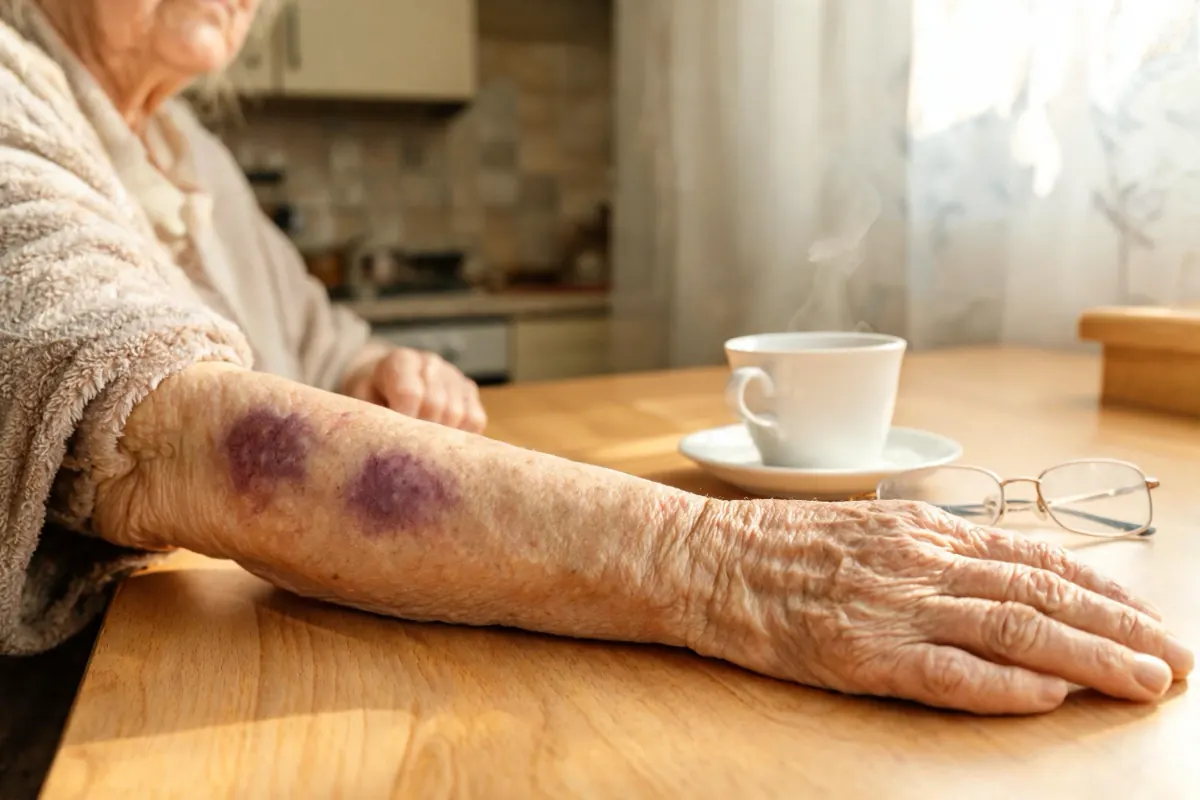
Senile purpura — the flat, dark-purple patches on older forearms and hands — is harmless, but many people find it upsetting. DermNet notes it is benign and recommends sun protection as the mainstay of management [1]. Beyond that, a growing number of creams target it. Here's how to choose.
The ingredients, ranked by evidence
| Rank | Ingredient | What it does | Best evidence |
|---|---|---|---|
| 1 | Sunscreen (SPF 30+) | Prevents further collagen damage | Core recommendation for actinic purpura [1] [11] |
| 2 | Moisturisers / ceramides | Keep thin skin supple, reduce tears | Twice-daily moisturising nearly halved skin tears [6] |
| 3 | High-strength arnica | Helps patches fade faster | 20% arnica beat placebo for laser bruises [2] |
| 4 | Vitamin K | Helps bruising fade when used after it forms | Reduced severity of laser bruises [3] |
| 5 | Retinoids | Rebuild skin matrix over months | Retinol on elderly arms increased procollagen [4] |
| 6 | Alpha-hydroxy acids | Thicken photoaged skin | ~25% increase in skin thickness in a pilot study [5] |
| Oral | Citrus bioflavonoids | Support small vessels | 50% fewer new lesions in 6 weeks vs. placebo [7] |
A dermatology review describes a multi-ingredient topical approach for actinic purpura combining retinol, AHAs, arnica, ceramides, niacinamide and vitamin K [8]. (It was funded by the maker of one such product.)
1. Reunoa Bruise Defense & Repair Serum — best for fragile skin that reacts easily
- Covers: fading (15% arnica, vitamin K) + barrier (ceramides) + niacinamide, vitamin C
- Leaves out: retinoids, acids, fragrance — gentler on very thin, reactive skin
- Format: light serum, absorbs in under a minute — easy for twice-daily use under sleeves
- Trade-off: no retinoid, so for structural "thickening" you'd add a separate gentle retinoid if you tolerate one
- Honesty note: our product. Ingredients · reviews incl. complaints
2. DerMend Moisturizing Bruise Formula — best all-in-one if you tolerate retinol
- Covers: arnica, phytonadione (vitamin K), five ceramides, retinol, glycolic acid, niacinamide [9]
- Strength: the broadest coverage of the evidence table in one cream
- Trade-off: retinol and glycolic acid can sting or peel very thin skin; arnica strength not stated
- Full comparison: Reunoa vs DerMend
3. Skintensive Bruise Cream — best fragrance-free option with vitamin K2
- Covers: arnica, vitamin K2, hesperidin (a citrus bioflavonoid), vitamins C and E, centella [10]
- Trade-off: no ceramides listed; topical K2 has less research than K1; arnica strength not stated
4. A plain ceramide moisturiser + sunscreen — best budget foundation
- Covers: barrier and prevention — ranks 1 and 2 in the evidence table
- Trade-off: doesn't target existing patches; pair with a bruise product when patches appear
5. Oral citrus bioflavonoids — best add-on, with your doctor's OK
- Evidence: a randomised, double-blind trial found 50% fewer purpura lesions after six weeks with a citrus bioflavonoid blend, with no adverse effects reported [7]
- Trade-off: a supplement, not a cream; check with your pharmacist if you take blood thinners or other medicines
How to build a routine
- Morning: purpura cream or serum on forearms and hands → sunscreen if going out.
- Evening: purpura cream again; if you tolerate retinoids, add a low-strength retinol two or three nights a week.
- Every day: light sleeves for gardening and chores; pad sharp furniture edges.
- Judge after 4–6 weeks. New patches will still appear sometimes — the goal is fewer and less noticeable.
See our full senile purpura guide and what causes senile purpura.
Frequently asked questions
What is the best cream for senile purpura?
The best options combine ingredients that help patches fade, such as high-strength arnica and vitamin K, with skin-strengthening ingredients such as ceramides, and retinoids or AHAs if your skin tolerates them. Use it twice daily with sunscreen.
What do dermatologists recommend for senile purpura?
Dermatology sources emphasise sun protection and moisturising, and describe topical regimens combining retinoids, alpha-hydroxy acids, arnica, ceramides, niacinamide and vitamin K. A doctor should check any purple spots in unusual places.
Does vitamin K cream help senile purpura?
Vitamin K cream reduced the severity of laser-induced bruising when applied after the bruise formed. It hasn't been studied on its own specifically for senile purpura, so it's best used as part of a routine.
Can senile purpura be cured?
No, because the underlying skin thinning can't be fully reversed. A consistent routine of sun protection, moisturising and targeted creams can make patches less frequent and less noticeable.
Is there a pill for senile purpura?
There's no medicine approved for it, but an oral citrus bioflavonoid blend reduced new lesions by 50% over six weeks in a placebo-controlled trial. Ask your pharmacist before adding any supplement.
Sources
- Senile purpura — DermNet (New Zealand).
- Leu S, et al. Accelerated resolution of laser-induced bruising with topical 20% arnica: a rater-blinded randomized controlled trial. British Journal of Dermatology, 2010. PubMed 20412090
- Shah NS, et al. The effects of topical vitamin K on bruising after laser treatment. Journal of the American Academy of Dermatology, 2002. PubMed 12140470
- Kafi R, et al. Improvement of naturally aged skin with vitamin A (retinol). Archives of Dermatology, 2007. PubMed 17515510
- Ditre CM, et al. Effects of alpha-hydroxy acids on photoaged skin: a pilot clinical, histologic, and ultrastructural study. Journal of the American Academy of Dermatology, 1996. PubMed 8642081
- Carville K, et al. The effectiveness of a twice-daily skin-moisturising regimen for reducing the incidence of skin tears. International Wound Journal, 2014. PubMed 25040325
- Berlin JM, et al. A randomized, placebo-controlled, double-blind study to evaluate the efficacy of a citrus bioflavanoid blend in the treatment of senile purpura. Journal of Drugs in Dermatology, 2011. PubMed 21720653
- Ceilley RI Treatment of Actinic Purpura. Journal of Clinical and Aesthetic Dermatology, 2017. PubMed 28979656
- DerMend Moisturizing Bruise Formula Cream — ingredient list — SkinSAFE ingredient database.
- Skintensive Bruise Cream — ingredients and directions — skintensive.com.
- How to select a sunscreen — American Academy of Dermatology.
General information, not medical advice. Written by the Reunoa editorial team; Reunoa makes Bruise Defense & Repair Serum. See our editorial policy for how we pick sources and keep product mentions fair.