What causes senile purpura? The 3 structural reasons
 By Margaret Hale, Reunoa EditorialLast updated
The short answer
Senile purpura is caused by thin, sun-damaged skin. Years of UV exposure and aging leave the dermis with less collagen and abnormal elastic fibres, so small blood vessels near the surface lose their support and tear with minimal friction. Leaked blood clears slowly. Blood thinners, aspirin and steroids make each patch larger but don't cause the fragility.
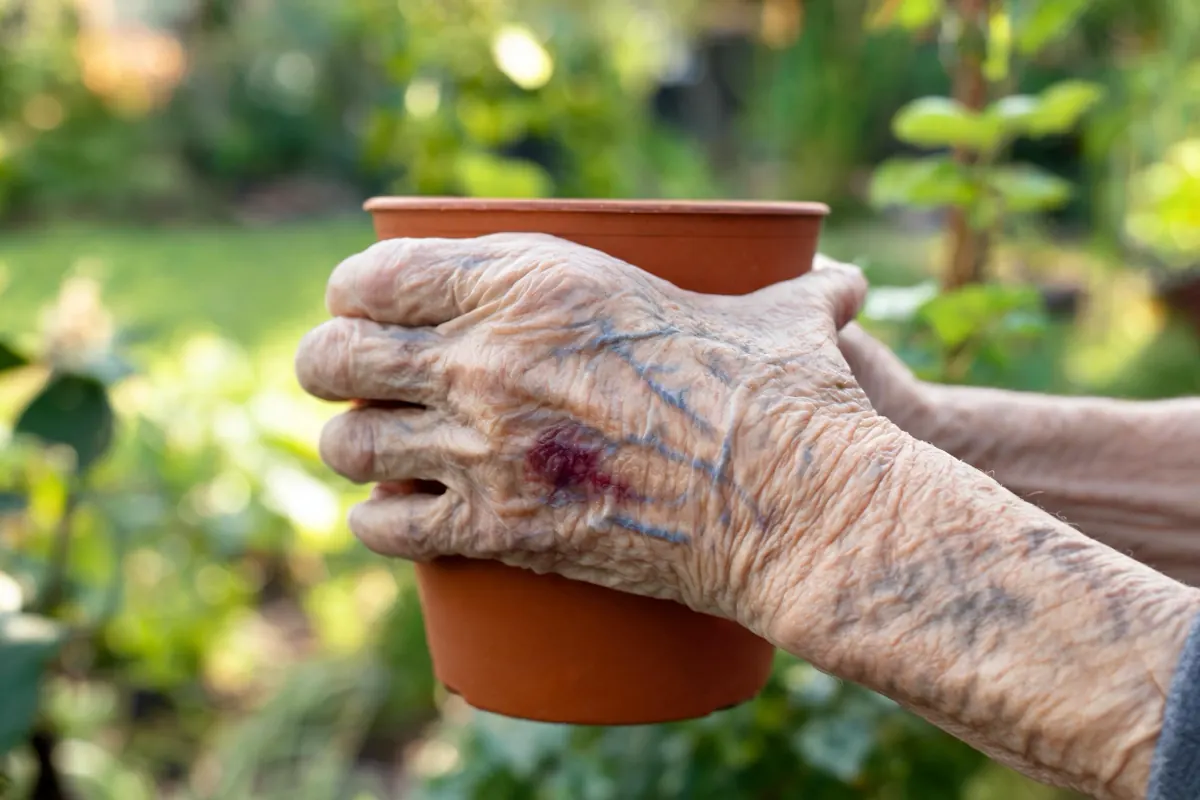
Senile purpura — also called actinic or Bateman purpura — isn't a blood problem. It's a structural skin problem. Three things go wrong at once.
Reason 1: The supporting layer gets thin
The dermis is the thick middle layer of skin, made mainly of collagen. With age and sun exposure, it thins, and its collagen is reduced and replaced by abnormal elastic fibres [1]. UV light directly breaks down collagen and slows new collagen production [3]. MedlinePlus notes that aging skin becomes thinner, more translucent and less strong [2].
That's why purpura appears almost only on the forearms and backs of the hands: the skin that has had the most sun.
Reason 2: Blood vessels lose their scaffolding
Here's the surprising part: the blood vessel walls themselves are normal [1]. What's missing is the firm collagen "scaffolding" around them. Without it, a twist, a rub or a light knock is enough to tear a small vessel. Blood spills into the loose surrounding tissue and spreads, creating the flat, sharply edged dark-purple patch.
Swiss dermatologists group this kind of fragile, bruise-prone, tear-prone skin under the term dermatoporosis — a skin version of osteoporosis [4].
Reason 3: Slow clean-up
In younger skin, cleaning cells quickly break down leaked blood, so a bruise goes through green and yellow and disappears. In thin, aged skin the process is slow. Purpura patches often stay purple and take up to three weeks to fade, and the iron left behind can stain the skin brown [1]. See hemosiderin staining.
What makes it worse (but doesn't cause it)
| Factor | Effect |
|---|---|
| Blood thinners and aspirin | More blood leaks before the tear seals, so patches are bigger [1] |
| Steroid tablets, inhalers or strong steroid creams | Long-term use thins the skin further [5] |
| Fair skin, outdoor work or hobbies | More lifetime UV damage |
| Dry skin | Less flexible, more prone to tears |
Senile purpura isn't caused by a clotting disorder: blood tests are rarely needed and are usually normal [1].
What this means for treatment
Because the cause is structural, the most useful steps target structure: protect from further sun damage, keep the skin barrier supple with twice-daily moisturising, reduce friction and knocks, and consider topical ingredients that support the skin and help marks fade. See our full senile purpura guide and best creams for senile purpura.
Frequently asked questions
What is the main cause of senile purpura?
Thin, sun-damaged skin. Aging and years of UV exposure reduce the collagen that supports small blood vessels, so they tear from minimal friction and leak blood into the skin.
Is senile purpura caused by a vitamin deficiency?
No. It's caused by structural changes in aging skin. Severe vitamin C deficiency can cause bruising too, but that's a different condition with other signs like bleeding gums.
Can blood thinners cause senile purpura?
They don't cause the underlying skin fragility, but they make each leak bigger and more visible. Many people notice purpura more after starting a blood thinner. Never stop a blood thinner because of it.
Why does senile purpura only appear on my arms?
Forearms and the backs of the hands have had the most sun exposure over your lifetime and get the most everyday knocks, so that's where the dermis is thinnest and vessels least supported.
Sources
- Senile purpura — DermNet (New Zealand).
- Aging changes in skin — MedlinePlus Medical Encyclopedia.
- Rittié L, Fisher GJ Natural and sun-induced aging of human skin. Cold Spring Harbor Perspectives in Medicine, 2015. PubMed 25561721
- Kaya G, Saurat JH Dermatoporosis: a chronic cutaneous insufficiency/fragility syndrome. Dermatology, 2007. PubMed 17911985
- Barnes L, et al. Topical corticosteroid-induced skin atrophy: a comprehensive review. Drug Safety, 2015. PubMed 25862024
General information, not medical advice. Written by the Reunoa editorial team; Reunoa makes Bruise Defense & Repair Serum. See our editorial policy for how we pick sources and keep product mentions fair.