Does sun damage cause thin skin?
 By Margaret Hale, Reunoa EditorialLast updated
The short answer
Yes. Ultraviolet light breaks down collagen and elastic fibres and disrupts skin renewal, so sun-exposed skin ages much faster than protected skin. That's why forearms and the backs of hands become thin, crepey and prone to bruising and purple patches. It's never too late: daily sunscreen slowed visible skin aging in a 4.5-year trial, and retinoids can rebuild some collagen.
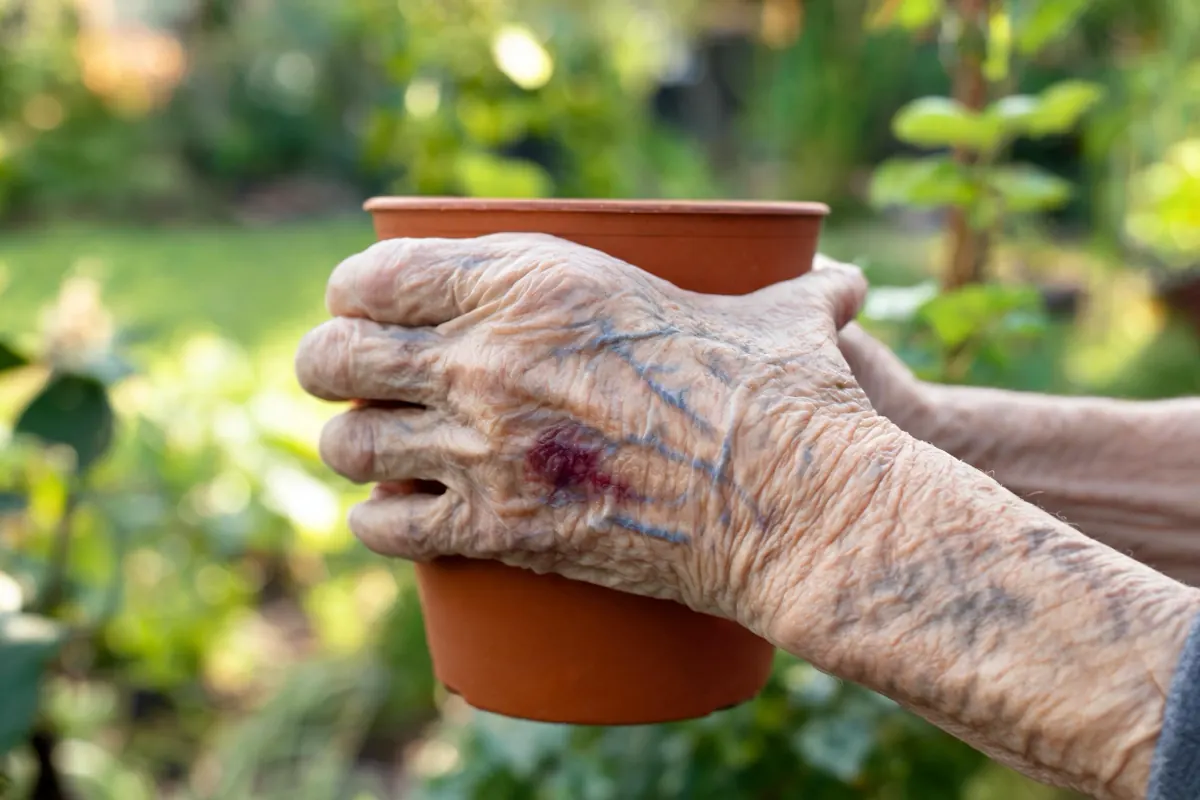
Hold your forearm next to the skin on the inside of your upper arm. The difference — thinner, more crinkled, spotted skin on the forearm — is mostly the sun.
How UV thins the skin
A review of natural and sun-induced skin aging explains that UV exposure triggers enzymes that break down collagen and leads to disorganized, damaged elastic fibres in the dermis [1]. Over decades this adds up to:
- less collagen supporting the skin and blood vessels
- abnormal elastic tissue that makes skin crepey rather than springy
- fragile small vessels that tear easily
- uneven pigmentation — age spots and freckles
Why it shows most on arms and hands
Forearms and the backs of the hands get sun almost every day: driving, gardening, walking. They're also where knocks happen most. That's why actinic (solar) purpura — purple patches from sun-weakened vessels — appears there [4].
Is it too late to protect your skin?
No. In a randomized trial of adults followed for 4.5 years, people who used sunscreen daily showed no detectable increase in skin aging, and aging was 24% less than in those who used sunscreen as they pleased [2]. Participants were healthy middle-aged adults, but the principle — less UV, less ongoing damage — applies at any age.
What helps sun-damaged thin skin
- Broad-spectrum sunscreen, SPF 30+, every morning on face, neck, forearms and hands [5]. Reapply after washing hands when outdoors.
- Sun-protective clothing — light long sleeves, wide-brimmed hats, UPF fabrics.
- Topical retinoids — retinol over 24 weeks increased procollagen in aged skin [3]; a review lists retinoids as a mainstay for photoaged skin [6].
- Moisturize twice daily — sun-damaged skin is drier.
- Protect from knocks while skin strengthens.
Sun damage and skin checks
Sun-damaged skin is also at higher risk of skin cancers. Check your skin monthly and see a doctor for any spot that's new, growing, changing, bleeding or not healing.
Signs of sun damage on arms and hands
- thin, crinkled, crepey skin
- age spots and uneven freckling
- purple patches after minor knocks (actinic purpura)
- white star-shaped scars from old tears
- rough, scaly spots (actinic keratoses) — these should be checked, as they can occasionally turn into skin cancer
Sun habits that protect thin skin
- Sunscreen as part of your morning routine, like brushing teeth
- Keep a small tube in the car for your hands and forearms
- Light long-sleeved shirts for gardening and walks
- Seek shade between late morning and mid-afternoon
Frequently asked questions
Can sun damage make your skin thinner?
Yes. UV breaks down collagen and damages elastic fibres, making sun-exposed skin thinner and more fragile over time.
Can sun-damaged skin be repaired?
Partly. Daily sunscreen prevents further damage, and retinoids can rebuild some collagen over months.
Why are my forearms so thin and crepey?
Forearms get daily sun for decades. UV damage plus natural aging makes them one of the first places skin becomes thin and crepey.
What SPF should I use for thin skin?
A broad-spectrum sunscreen of SPF 30 or higher, applied every morning to exposed skin.
Sources
- Rittié L, Fisher GJ Natural and sun-induced aging of human skin. Cold Spring Harbor Perspectives in Medicine, 2015. PubMed 25561721
- Hughes MC, et al. Sunscreen and prevention of skin aging: a randomized trial. Annals of Internal Medicine, 2013. PubMed 23732711
- Kafi R, et al. Improvement of naturally aged skin with vitamin A (retinol). Archives of Dermatology, 2007. PubMed 17515510
- Senile purpura — DermNet (New Zealand).
- How to select a sunscreen — American Academy of Dermatology.
- Sadick N, et al. Topical Treatments for Photoaged Skin. Journal of Drugs in Dermatology, 2023. PubMed 37683070
General information, not medical advice. Written by the Reunoa editorial team; Reunoa makes Bruise Defense & Repair Serum. See our editorial policy for how we pick sources and keep product mentions fair.