Why is my skin so thin all of a sudden?
 By Margaret Hale, Reunoa EditorialLast updated
The short answer
Skin thins gradually with age, but it often seems sudden because the change crosses a tipping point — you start to bruise, tear or see veins more easily. The usual causes are natural aging, decades of sun exposure, long-term steroid tablets, inhalers or creams, the drop in estrogen after menopause, and weight loss. A rapid change with other symptoms deserves a doctor's check.
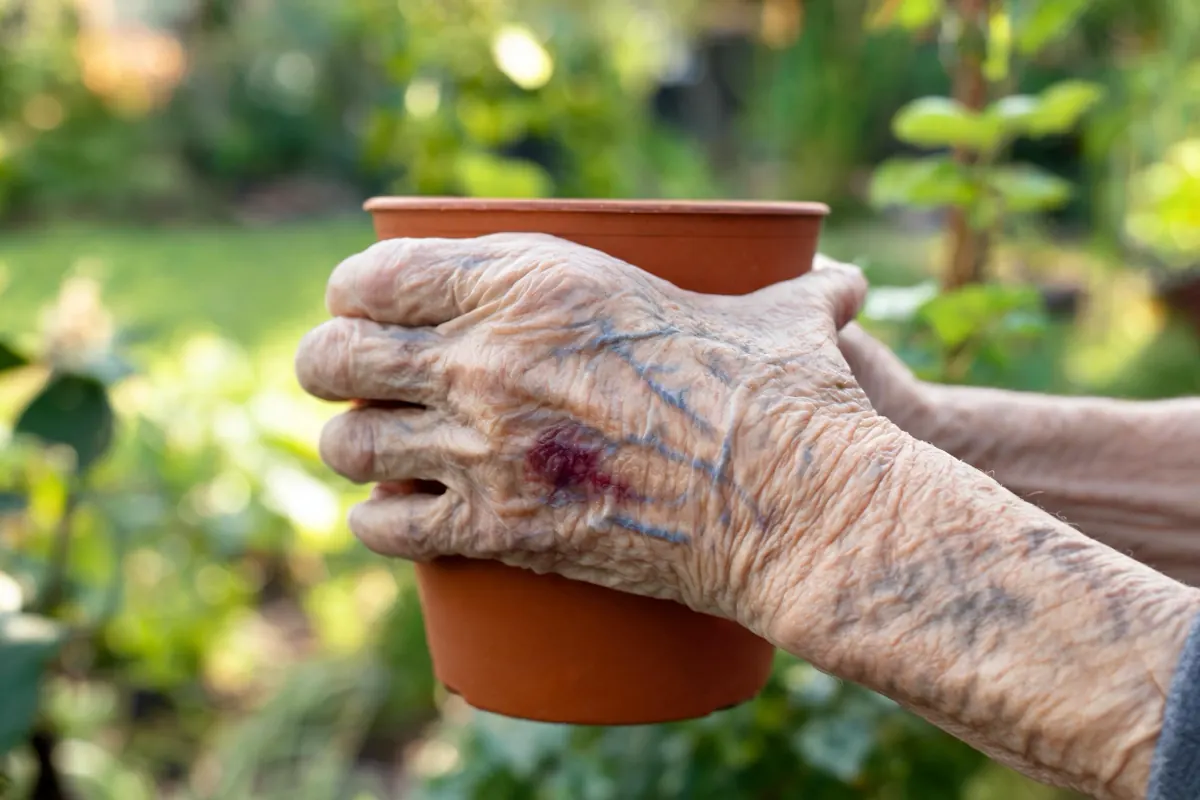
You look at your forearm one day and see veins you never noticed, and a scratch that would once have been nothing has torn the skin. It's a common moment: in our anonymous quiz of U.S. adults over 55, 68% said the skin on their forearms feels noticeably thinner than ten years ago, and another 17% said it feels "like wet tissue paper" [8].
1. Natural aging
With age, the outer layer of skin thins, the skin becomes paler and more translucent, the connective tissue weakens and the fat layer underneath shrinks [1]. Measurements show skin thickness and structure change steadily over the decades [2]. The change is slow, but once it passes a certain point you start to notice bruises and tears.
2. Decades of sun
Sun exposure is the biggest single factor in how skin ages [1]. UV light breaks down collagen and elastic fibres in the dermis [3]. That's why forearms and the backs of the hands — which see the most sun — thin first, while the skin on your upper arms or stomach may still look much younger.
3. Steroid medicines
Long-term steroid tablets such as prednisone [5], and strong steroid creams used on the same area for months, can thin the skin. Skin thinning is linked mainly to long-term rather than short courses [4]. If you notice thinning, don't stop a prescribed steroid — ask your doctor whether the dose, strength or how often you use it can be adjusted.
4. Menopause
Estrogen helps keep skin thick, hydrated and rich in collagen. After menopause, skin tends to become drier and thinner, and oil production falls [1].
5. Weight loss or illness
Losing weight, especially quickly, reduces the fat cushion under the skin. Periods of illness, poor appetite or low protein intake can also leave skin more fragile.
6. Dryness
Dry skin isn't thinner in structure, but it's stiffer and splits more easily. Twice-daily moisturising almost halved skin tears in an aged-care trial [7].
7. "Dermatoporosis"
Dermatologists use the term dermatoporosis for the combination of very thin skin, easy bruising (purpura), white star-shaped scars and frequent tears in older adults — likening it to osteoporosis of the skin [6]. If that describes your skin, it's worth treating as a long-term condition to protect, like your bones.
What helps
- Moisturise twice daily with a fragrance-free product, ideally with ceramides. See ceramides for fragile skin.
- Protect from the sun with SPF 30+ and light sleeves.
- Consider retinoids carefully — they can thicken skin over months but may irritate. See retinol for thin skin.
- Protect against knocks — pad furniture edges, wear sleeves for gardening.
- Eat enough protein and vitamin C to support skin repair.
Frequently asked questions
Why is my skin suddenly so thin and bruising easily?
Skin thins gradually with age and sun exposure, but once it passes a tipping point you suddenly notice easy bruising and tears. Steroid medicines, blood thinners, menopause and weight loss can speed this up. Sudden widespread changes should be checked by a doctor.
Can thin skin be reversed?
Partly. Retinoids and alpha-hydroxy acids have been shown to increase skin thickness over months, and moisturising and sun protection prevent further damage. Skin won't return to how it was at 30, but it can become sturdier.
What vitamin is good for thin skin?
Vitamin C is needed to make collagen, and topical vitamin A derivatives (retinoids) can thicken aged skin. A varied diet with enough protein, fruit and vegetables supports skin. Ask your doctor before taking high-dose supplements.
Does thin skin mean something is wrong?
Usually it's a normal part of aging and sun exposure. It can also be a side effect of long-term steroids. Rapid thinning with other symptoms such as weight gain in the face or muscle weakness should be checked by a doctor.
Sources
- Aging changes in skin — MedlinePlus Medical Encyclopedia.
- Waller JM, Maibach HI Age and skin structure and function, a quantitative approach (I): blood flow, pH, thickness, and ultrasound echogenicity. Skin Research and Technology, 2005. PubMed 16221138
- Rittié L, Fisher GJ Natural and sun-induced aging of human skin. Cold Spring Harbor Perspectives in Medicine, 2015. PubMed 25561721
- Barnes L, et al. Topical corticosteroid-induced skin atrophy: a comprehensive review. Drug Safety, 2015. PubMed 25862024
- Prednisone — Drug Information — MedlinePlus.
- Kaya G, Saurat JH Dermatoporosis: a chronic cutaneous insufficiency/fragility syndrome. Dermatology, 2007. PubMed 17911985
- Carville K, et al. The effectiveness of a twice-daily skin-moisturising regimen for reducing the incidence of skin tears. International Wound Journal, 2014. PubMed 25040325
- Fragile Skin Report 2027 — aggregated, anonymous answers from the Reunoa skin quiz — Reunoa Editorial (learn.reunoa.com).
General information, not medical advice. Written by the Reunoa editorial team; Reunoa makes Bruise Defense & Repair Serum. See our editorial policy for how we pick sources and keep product mentions fair.