Why do I bruise so easily? 9 reasons after 60 — and what actually helps
 By Margaret Hale, Reunoa EditorialLast updated
The short answer
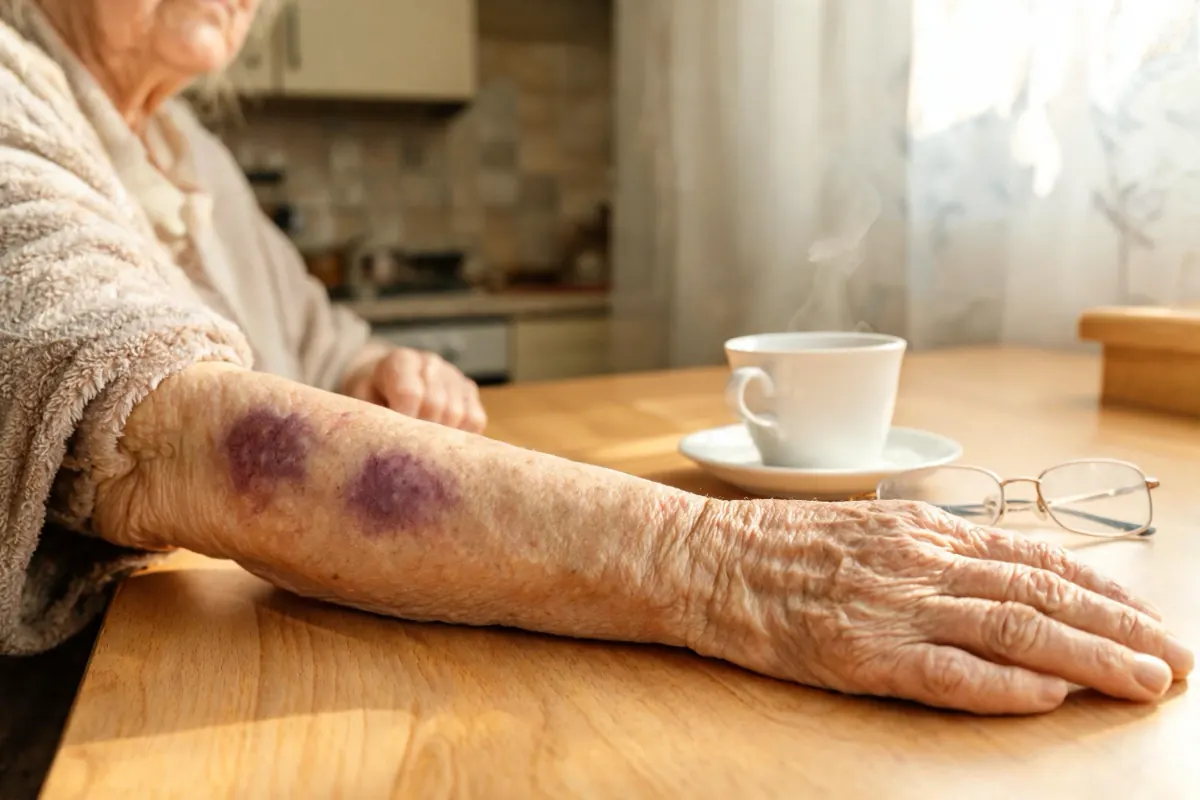
Most easy bruising after 60 is caused by skin that has become thinner, with less collagen and less protective fat, so tiny blood vessels break from bumps you barely notice. Sun damage and common medicines such as aspirin, blood thinners and steroids add to it. Unexplained bruising with other bleeding or symptoms should be checked by a doctor.
Key takeaways
- Skin loses thickness, fat padding and collagen with age, so small vessels break more easily [1].
- Decades of sun exposure weaken the skin on forearms and hands most — which is exactly where most bruises appear.
- Blood thinners, daily aspirin and steroid medicines make bruising more likely. Keep taking them as prescribed and talk to your doctor if bruising bothers you.
- Bruises that come with nosebleeds, bleeding gums, blood in urine, or that appear in unusual places need a medical check [2].
- Moisturising twice a day, protecting your arms and choosing the right topical ingredients can make skin more resilient.
On this page
- How a bruise forms (in 30 seconds)
- 1. Your skin has become thinner
- 2. Less fat padding under the skin
- 3. Your blood vessels are more fragile
- 4. Decades of sun
- 5. Blood thinners (anticoagulants)
- 6. Daily aspirin and antiplatelet medicines
- 7. Steroid medicines and creams
- 8. Low vitamin C or vitamin K
- 9. A medical condition (less common, but important)
- What actually helps
- Frequently asked questions
If you've ever looked down at a purple patch on your forearm and thought "When did I do that?" — you're in very large company. In our own anonymous survey of more than 7,600 U.S. adults over 55, nearly half said there is "always at least one bruise somewhere", and three in four said their bruises appear mainly on the forearms and backs of the hands [12].
Easy bruising is rarely a mystery once you know what changes in skin after 60. Below are the nine most common reasons, roughly in order of how often they play a part — followed by what genuinely helps and the warning signs that mean a doctor should take a look.
How a bruise forms (in 30 seconds)
A bruise is blood that has leaked out of tiny vessels (capillaries) into the surrounding tissue after a knock. The blood is trapped under the skin, so you see it through the surface — first red or purple, later green, yellow and brown as your body breaks it down and clears it [2].
Young skin has a thick, springy cushion of collagen and fat around those capillaries. Older skin has much less, so the same small bump that left no mark at 30 now leaves a bruise that lasts for weeks.
1. Your skin has become thinner
With age, the outer layer of skin thins, the skin looks paler and more translucent, and the connective tissue that gives it strength weakens [1]. Researchers have measured this: skin thickness, its blood flow and its structure all change steadily with age [5]. Dermatologists in Geneva coined the term dermatoporosis — "skin osteoporosis" — for the fragile, easily bruised and easily torn skin that results [4].
Thinner skin means less protection for the capillaries below. That is the single biggest reason bruises come so easily.
2. Less fat padding under the skin
The fat layer beneath the skin also shrinks with age, which gives "less insulation and padding" and raises the risk of skin injury [1]. On the backs of the hands and forearms there was never much fat to begin with — so these areas lose their cushion first.
3. Your blood vessels are more fragile
MedlinePlus, the U.S. National Library of Medicine's health site, puts it plainly: in older skin, "the blood vessels of the dermis become more fragile", which leads to bruising and bleeding under the skin often called senile purpura [1]. These are the flat, dark purple patches that many people over 65 get on their forearms. Read our full senile purpura guide.
4. Decades of sun
Sun exposure is the greatest single factor in how skin ages [1]. Ultraviolet light breaks down collagen and elastic fibres in the dermis, the layer that supports blood vessels [3]. That is why bruising clusters on the forearms and hands — the parts of your body that have seen the most sun over a lifetime — and much less on your upper arms or stomach.
5. Blood thinners (anticoagulants)
Medicines such as warfarin, apixaban (Eliquis), rivaroxaban (Xarelto) and dabigatran slow down blood clotting. That is exactly what they are prescribed to do — they protect you from strokes and dangerous clots. A side effect is that a small leak from a capillary takes longer to stop, so bruises can be larger and more frequent [6].
These medicines are life-saving. Never stop or reduce a blood thinner because of bruising. Talk to your doctor or pharmacist if bruises worry you. See our guide to bruising on blood thinners.
6. Daily aspirin and antiplatelet medicines
Low-dose aspirin and clopidogrel (Plavix) make platelets less sticky. In the large ASPREE trial of more than 19,000 healthy older adults, daily low-dose aspirin was linked to more major bleeding than placebo [7]. Everyday bruising is a much milder, common sign of the same effect. If you take aspirin on your own rather than on a doctor's advice, it's worth asking whether you still need it — but don't stop a prescribed dose without speaking to your doctor. More in Does daily aspirin cause bruising?
7. Steroid medicines and creams
Long-term steroid tablets (such as prednisone) and strong steroid creams can thin the skin. A review of topical corticosteroids found that skin thinning is mainly linked to long-term rather than short-term use [8]. If you use a steroid cream on the same area for months, ask your doctor whether a lower strength or a break is possible.
8. Low vitamin C or vitamin K
Severe vitamin C deficiency (scurvy) causes easy bruising, bleeding gums and slow healing. It still happens in older adults with very limited diets [9]. Vitamin K is needed for normal clotting. Deficiency is uncommon in healthy adults, but a poor diet, some gut conditions or antibiotics can play a role. If you eat very little fruit and vegetables, mention bruising to your doctor — it's an easy blood test.
9. A medical condition (less common, but important)
Sometimes easy bruising is a sign of a problem with platelets, clotting factors, the liver or the bone marrow. A doctor will usually start with a simple blood count and clotting tests [10]. This is why unexplained bruising together with other symptoms deserves attention.
What actually helps
You can't turn back the clock on skin, but you can make it more resilient and help marks fade.
- Moisturise twice a day. In a cluster-randomised trial in aged-care homes, a twice-daily moisturising routine cut skin tears by almost half compared with usual care [11]. Well-hydrated skin is more flexible and less likely to split or bruise from friction.
- Protect your arms. Long, light sleeves for gardening, padded corners on furniture and moving clutter out of walkways reduce the bumps that cause bruises. Our 12 everyday habits list has more.
- Use sunscreen on forearms and hands. It won't undo past damage, but it slows further breakdown of collagen [3].
- Choose topical ingredients with some evidence. High-strength arnica, vitamin K and barrier-repairing ceramides have been studied for bruising and fragile skin. See how to get rid of bruises faster and our ingredient guides.
- Review your medicines with your doctor or pharmacist. Not to stop anything — but to check that every medicine and supplement is still needed. Fish oil, vitamin E and ginkgo, for example, can add to a blood thinner's effect.
Frequently asked questions
Is it normal to bruise easily after 60?
Yes. Thinner skin, less fat padding and more fragile blood vessels make easy bruising very common after 60, especially on the forearms and hands. It becomes a concern when bruising is sudden and unexplained or comes with other bleeding, such as nosebleeds or bleeding gums.
Why do I get bruises and don't remember hitting anything?
With thin skin, the bump that causes a bruise can be so light you never notice it — brushing a door frame or a pet's paw is enough. Blood thinners and aspirin make this more likely. Bruises that appear with no knock at all, in unusual places, should be checked by a doctor.
Can low vitamins cause easy bruising?
Yes, severe vitamin C deficiency causes easy bruising and bleeding gums, and low vitamin K can affect clotting. Both are uncommon with a varied diet. If you eat little fruit and vegetables, ask your doctor about a simple blood test rather than guessing with supplements.
Should I stop my blood thinner if I bruise a lot?
No. Never stop or change a blood thinner on your own — it protects you from strokes and dangerous clots. Tell your doctor or pharmacist about the bruising. They can check your dose, your other medicines and whether anything else is contributing.
What is the best cream for easy bruising?
Look for creams with researched ingredients at meaningful strength: high-concentration arnica, vitamin K and ceramides for the skin barrier. Very diluted homeopathic arnica has not shown benefit in trials. Compare options in our best bruise creams guide.
When is easy bruising a sign of something serious?
When bruises appear suddenly without a cause, are very large, don't fade after several weeks, show up on the trunk or back, or come with other bleeding, fever, weight loss or tiredness. A doctor can run a blood count and clotting tests to rule out a blood disorder.
Sources
- Aging changes in skin — MedlinePlus Medical Encyclopedia.
- Bleeding into the skin — MedlinePlus Medical Encyclopedia (U.S. National Library of Medicine).
- Rittié L, Fisher GJ Natural and sun-induced aging of human skin. Cold Spring Harbor Perspectives in Medicine, 2015. PubMed 25561721
- Kaya G, Saurat JH Dermatoporosis: a chronic cutaneous insufficiency/fragility syndrome. Dermatology, 2007. PubMed 17911985
- Waller JM, Maibach HI Age and skin structure and function, a quantitative approach (I): blood flow, pH, thickness, and ultrasound echogenicity. Skin Research and Technology, 2005. PubMed 16221138
- Blood Thinners — MedlinePlus (U.S. National Library of Medicine).
- McNeil JJ, et al. Effect of Aspirin on Cardiovascular Events and Bleeding in the Healthy Elderly (ASPREE). New England Journal of Medicine, 2018. PubMed 30221597
- Barnes L, et al. Topical corticosteroid-induced skin atrophy: a comprehensive review. Drug Safety, 2015. PubMed 25862024
- Olmedo JM, et al. Scurvy: a disease almost forgotten. International Journal of Dermatology, 2006. PubMed 16911372
- Ballas M, Kraut EH Bleeding and bruising: a diagnostic work-up. American Family Physician, 2008. PubMed 18481559
- Carville K, et al. The effectiveness of a twice-daily skin-moisturising regimen for reducing the incidence of skin tears. International Wound Journal, 2014. PubMed 25040325
- Fragile Skin Report 2027 — aggregated, anonymous answers from the Reunoa skin quiz — Reunoa Editorial (learn.reunoa.com).
General information, not medical advice. Written by the Reunoa editorial team; Reunoa makes Bruise Defense & Repair Serum. See our editorial policy for how we pick sources and keep product mentions fair.