Is Arnicare good for bruises?
 By Margaret Hale, Reunoa EditorialLast updated
The short answer
Arnicare Gel is a homeopathic arnica gel (Arnica montana 1X HPUS 7%): 7% of the gel is a 1:10 dilution of arnica tincture. It's convenient and inexpensive for an occasional knock. But the strongest bruise evidence is for 20% arnica ointment, while homeopathic arnica didn't beat placebo after surgery. Its alcohol-based gel can dry thin skin with frequent use.
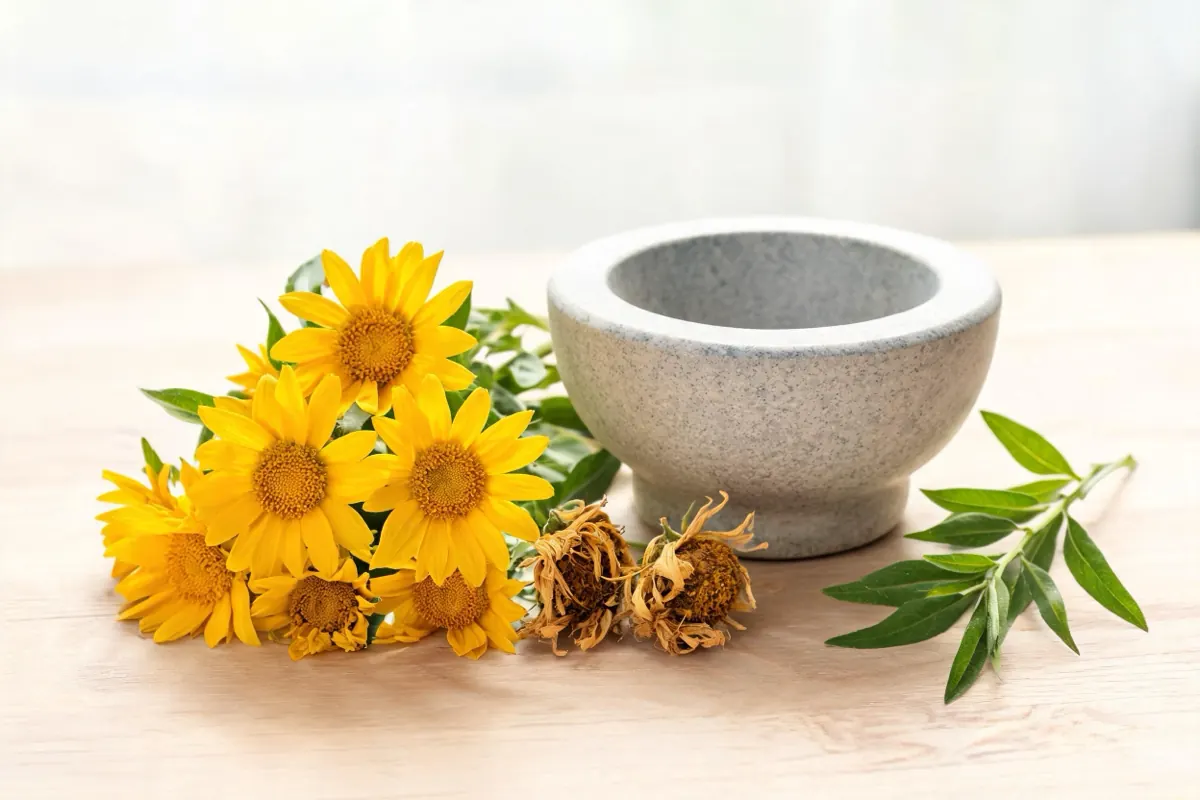
Arnicare, made by Boiron, is probably the most widely sold arnica product in US pharmacies. It's a staple in many medicine cabinets — but is it a good choice for bruises, especially on older skin?
What's in Arnicare Gel
The label lists Arnica montana 1X HPUS 7% as the active ingredient in a gel base [1]. In homeopathic notation, "1X" means a 1:10 dilution of arnica tincture, and 7% of the gel is that dilution. So the amount of arnica is meaningful but much lower than in a product stating, for example, "20% arnica".
What the evidence says
- 20% arnica ointment helped laser-induced bruises fade faster than placebo in a rater-blinded RCT [2].
- Homeopathic arnica (oral) didn't reduce bruising compared with placebo after eyelid surgery [3].
- A systematic review found mixed results for arnica after procedures; most trials used oral homeopathic arnica [4].
- For joint pain, an arnica gel performed similarly to ibuprofen gel for hand osteoarthritis in one trial — a different use and a different arnica preparation [5].
We found no published randomized trial of Arnicare Gel specifically on bruises.
Pros and cons for older skin
| Pros | Cons |
|---|---|
| Inexpensive, available everywhere | Lower arnica content than high-strength products |
| Fast-drying, non-greasy | Alcohol-based gel can dry thin skin with frequent use |
| Fine for an occasional bump or sore muscle | No vitamin K or barrier ingredients |
| Familiar brand | Homeopathic labelling can be confusing |
When Arnicare makes sense
- an occasional knock or sore muscle
- people who prefer a gel and don't use it daily
- as a travel or handbag option
When something else may suit better
- daily bruising or senile purpura on thin skin
- dry, fragile skin that dislikes alcohol-based gels
- wanting a stated high-strength arnica plus vitamin K and ceramides
Allergy reminder
Arnica belongs to the daisy family. If you're allergic to ragweed, chamomile or marigold, patch-test first [6].
How to use Arnicare well
- Apply to unbroken skin only, up to three times a day per the label [1].
- Wait 5 minutes after heat or ice before applying, as the label advises.
- If using often on thin forearms, follow with a fragrance-free moisturizer to offset the drying alcohol base.
- Stop if the skin becomes red or itchy.
Frequently asked questions
Does Arnicare work on bruises?
It may help some people with occasional bruises. The strongest trial evidence is for high-strength (20%) arnica; homeopathic arnica didn't beat placebo in a surgical trial.
What does 1X HPUS 7% mean?
7% of the gel is a 1:10 dilution of arnica tincture, prepared according to the Homeopathic Pharmacopoeia of the United States.
Is Arnicare safe for elderly skin?
It's generally well tolerated on unbroken skin, but the alcohol base can dry thin skin with frequent use. Patch-test if you have daisy-family allergies.
Is Arnicare or DerMend better for bruises?
They're different: Arnicare is a homeopathic arnica gel for occasional use; DerMend combines arnica, vitamin K, ceramides, retinol and glycolic acid for aging skin. See our comparison.
Can I use Arnicare every day?
The label allows use up to three times daily. For daily long-term use on thin forearm skin, follow with a moisturizer, as the alcohol base can be drying.
Sources
- Arnicare Gel — ingredients (Arnica montana 1X HPUS 7%) — Boiron / arnicare.com.
- Leu S, et al. Accelerated resolution of laser-induced bruising with topical 20% arnica: a rater-blinded randomized controlled trial. British Journal of Dermatology, 2010. PubMed 20412090
- Kotlus BS, et al. Evaluation of homeopathic Arnica montana for ecchymosis after upper blepharoplasty: a placebo-controlled, randomized, double-blind study. Ophthalmic Plastic and Reconstructive Surgery, 2010. PubMed 20683279
- Ho D, et al. Is There a Role for Arnica and Bromelain in Prevention of Post-Procedure Ecchymosis or Edema? A Systematic Review of the Literature. Dermatologic Surgery, 2016. PubMed 27035499
- Widrig R, et al. Choosing between NSAID and arnica for topical treatment of hand osteoarthritis in a randomised, double-blind study. Rheumatology International, 2007. PubMed 17318618
- Gordon LA Compositae dermatitis. Australasian Journal of Dermatology, 1999. PubMed 10439521
General information, not medical advice. Written by the Reunoa editorial team; Reunoa makes Bruise Defense & Repair Serum. See our editorial policy for how we pick sources and keep product mentions fair.