Broken blood vessels on your arms: what causes them and what helps
 By Margaret Hale, Reunoa EditorialLast updated
The short answer
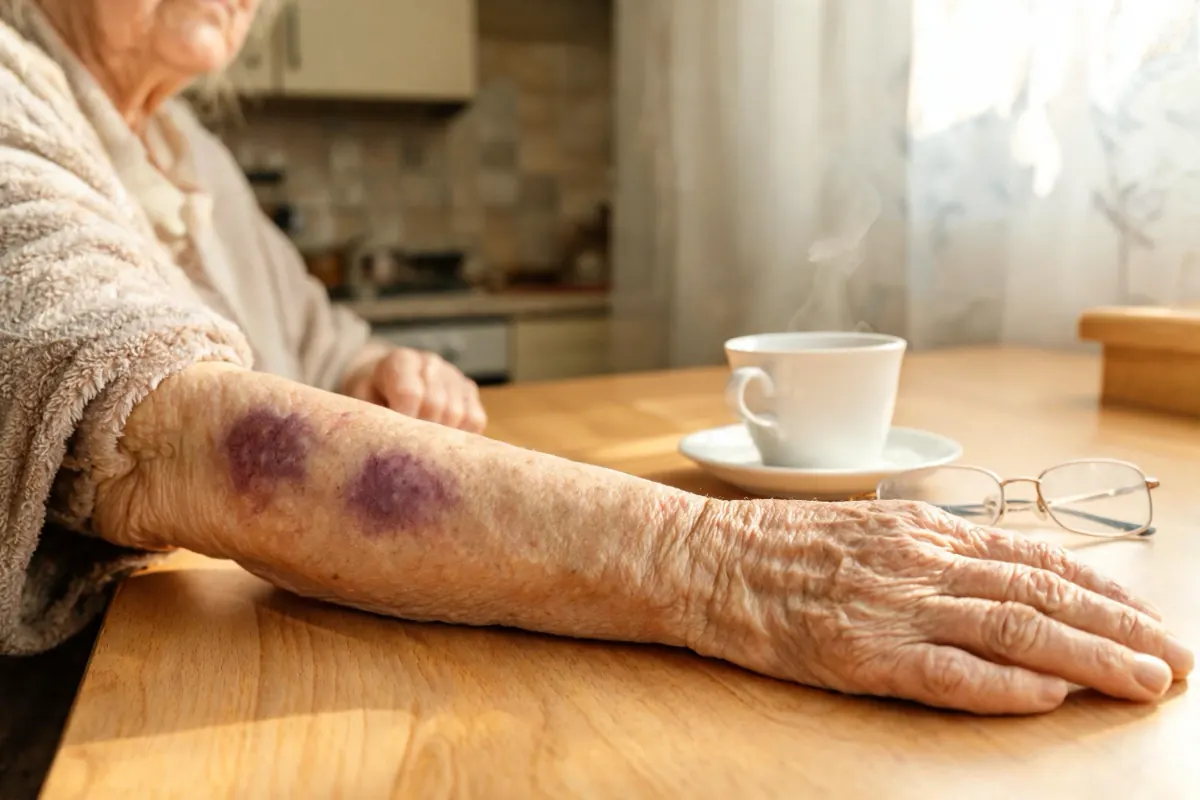
Broken blood vessels on the arms after 50 are most often senile (actinic) purpura: tiny vessels under thin, sun-damaged skin break after minor knocks and leak blood into flat purple patches. Blood thinners, aspirin and steroids make it more common. Pinpoint red dots, raised spots or bleeding elsewhere are different and need a doctor.
Key takeaways
- Thin, sun-damaged skin leaves small vessels poorly supported, so they tear easily [1].
- Blood thinners and steroids make leaks bigger and more frequent [3] [4].
- Pinpoint dots under 4 mm (petechiae) and raised spots need checking [2].
- Cherry angiomas are harmless raised red dots, not broken vessels [5].
- Sun protection, moisturizing and protecting the arms reduce new leaks.
On this page
"Broken blood vessels" is how many people describe the purple and red marks that start appearing on their arms in their 60s and 70s. It's a good description: in most cases, tiny vessels really have broken and leaked a little blood into the skin.
Why vessels break more easily with age
Small blood vessels in the skin are cushioned by collagen and elastic fibres in the dermis. With age — and especially with years of sun — that support thins out [7]. Studies measuring aged skin show changes in thickness and blood flow with age [8]. Without support, vessels tear from forces that wouldn't affect younger skin, such as a sleeve rubbing or a light bump [1].
The main types
Senile (actinic) purpura
Flat, dark-purple patches 1–4 cm wide with sharp edges on the outer forearms and backs of the hands. Benign, fades over one to three weeks [1]. This is by far the most common reason for "broken blood vessels" on older arms. See actinic purpura.
Bigger bruises on medicines
Blood thinners (Eliquis, Xarelto, warfarin), antiplatelets (aspirin, Plavix) and steroids (prednisone, inhalers, strong creams) let small leaks spread further [3] [4].
Petechiae
Pinpoint red or purple dots under 4 mm [2]. A few after straining or coughing can be harmless, but crops of petechiae — especially with fever, tiredness or bleeding gums — need prompt medical attention.
Cherry angiomas (not broken)
Bright red, raised, dome-shaped dots 1–10 mm. They're harmless overgrowths of small vessels, not leaks, and don't fade [5].
Spider veins
Fine red or blue lines, more common on legs and face than arms. Dilated, not broken.
Comparison
| What you see | Most likely |
|---|---|
| Flat purple patch, sharp edges, forearm | Senile purpura |
| Large purple bruise after a small bump, on blood thinner | Medicine-related bruising |
| Pinpoint red dots | Petechiae — get checked |
| Raised bright-red dot that stays | Cherry angioma |
| Fine red lines | Spider veins |
What helps
- Sunscreen and long sleeves — protect the collagen you still have [1].
- Moisturize twice daily — supple skin handles friction better.
- Avoid friction — soft fabrics, no tight watch straps or bag handles on the forearm.
- Medication review — ask whether all blood-thinning medicines and supplements are still needed.
- Supplements — a citrus bioflavonoid supplement reduced new purpura lesions by 50% in a six-week trial [9]. Ask your pharmacist.
- Topical care with ingredients such as arnica, vitamin K and ceramides — see senile purpura treatment.
Track what you see: a weekly photo of your forearms in daylight, with a coin for scale, makes it easy to tell whether patches follow the usual pattern — appearing, staying purple and fading within three weeks.
Frequently asked questions
What causes broken blood vessels on arms in elderly people?
Thin, sun-damaged skin with weak support around small vessels, so they break after minor knocks. Blood thinners and steroids make it worse. This is called senile or actinic purpura.
Are broken blood vessels on arms serious?
Usually not. Senile purpura is benign. See a doctor for pinpoint dots, raised spots or broken vessels with other bleeding or feeling unwell.
How do you fix broken blood vessels on arms?
Each patch fades on its own in one to three weeks. Sun protection, moisturizing, protecting your arms and topical products can reduce new ones.
Can stress cause broken blood vessels on arms?
Not directly. Straining, heavy coughing or vomiting can cause petechiae, mostly on the face and chest. On the arms, sun damage, age and medicines are much more common causes.
Sources
- Senile purpura — DermNet (New Zealand).
- Purpura — MedlinePlus Medical Encyclopedia.
- Blood Thinners — MedlinePlus (U.S. National Library of Medicine).
- Prednisone — Drug Information — MedlinePlus.
- Cherry angioma — DermNet.
- Bleeding into the skin — MedlinePlus Medical Encyclopedia (U.S. National Library of Medicine).
- Rittié L, Fisher GJ Natural and sun-induced aging of human skin. Cold Spring Harbor Perspectives in Medicine, 2015. PubMed 25561721
- Waller JM, Maibach HI Age and skin structure and function, a quantitative approach (I): blood flow, pH, thickness, and ultrasound echogenicity. Skin Research and Technology, 2005. PubMed 16221138
- Berlin JM, et al. A randomized, placebo-controlled, double-blind study to evaluate the efficacy of a citrus bioflavanoid blend in the treatment of senile purpura. Journal of Drugs in Dermatology, 2011. PubMed 21720653
General information, not medical advice. Written by the Reunoa editorial team; Reunoa makes Bruise Defense & Repair Serum. See our editorial policy for how we pick sources and keep product mentions fair.