Purple spots on your arms: what causes them and when to worry
 By Margaret Hale, Reunoa EditorialLast updated
The short answer
Purple spots on the arms of older adults are most often senile (actinic) purpura — flat, harmless patches caused by sun-thinned skin and fragile blood vessels — or bruises made bigger by blood thinners, aspirin or steroids. See a doctor if the spots are tiny pinpoint dots, raised or itchy, appear on the legs or trunk too, or come with other bleeding or feeling unwell.
Key takeaways
- Senile purpura affects more than 10% of people over 50 and is benign [1].
- Blood thinners, aspirin and steroids make purple spots more frequent and larger [3] [4].
- Tiny pinpoint spots (petechiae, under 4 mm) are different and need checking [2].
- Low platelets, vitamin C deficiency and vessel inflammation are less common causes [2] [5].
- Sun protection, moisturizing and protecting your arms reduce new spots.
On this page
You roll up your sleeve and there they are: purple blotches you don't remember getting. After 50, this is one of the most common skin worries. Most causes are harmless — but a few aren't, and they look different.
The 7 most common causes
1. Senile (actinic) purpura — the usual suspect
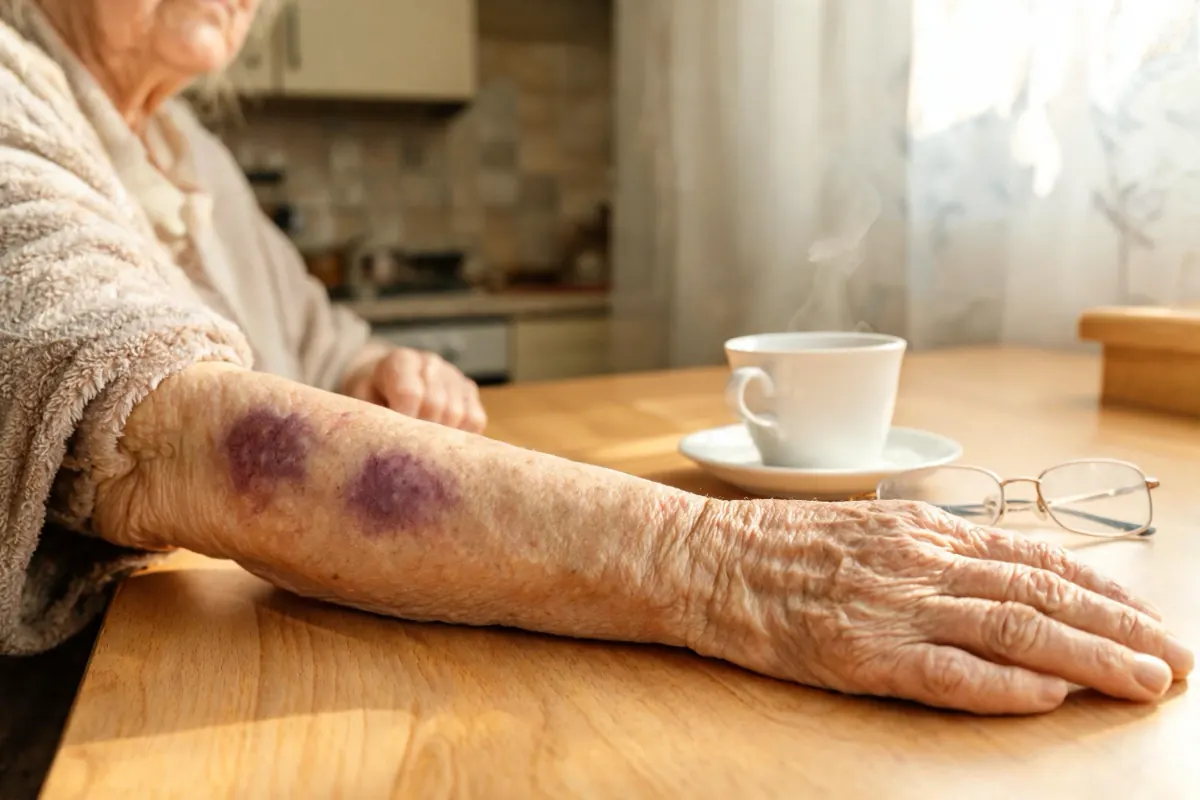
Flat, dark-purple patches 1–4 cm wide with sharp edges on the outer forearms and backs of the hands. They appear after tiny knocks, stay purple, fade over one to three weeks and often leave brown marks. It affects more than 10% of people over 50 and is benign [1]. Full guide: senile purpura.
2. Bruises on blood thinners or aspirin
Eliquis, Xarelto, warfarin, Plavix and daily aspirin all make bruises appear from smaller bumps and grow larger [3]. Expected — not a reason to stop. See bruising on blood thinners.
3. Steroid medicines
Long-term prednisone, inhaled steroids and strong steroid creams can thin the skin and cause easy bruising [4]. See steroid skin thinning.
4. Ordinary bruises
A noticeable knock, a blood draw, a tight blood-pressure cuff. These are tender, have blurred edges and change colour.
5. Petechiae
Tiny pinpoint red or purple dots under 4 mm that don't fade when pressed [2]. They can follow straining, coughing or vomiting, but can also be a sign of low platelets or infection — get them checked, especially with fever.
6. Cherry angiomas
Small, raised, bright red to purple bumps (1–10 mm) that are harmless and don't fade [8]. Often on the trunk and arms.
7. Less common medical causes
Low platelet count, clotting problems, vitamin C deficiency (scurvy) and inflammation of small blood vessels (vasculitis) can all cause purple spots [2] [5] [6]. These usually come with other signs — see below.
Quick comparison
| Looks like | Likely cause |
|---|---|
| Flat, sharp-edged, dark purple, forearms, no pain | Senile purpura |
| Larger patches after small bumps, on a blood thinner | Medicine-related bruising |
| Tender, swollen, colour changes | Ordinary bruise |
| Many tiny pinpoint dots | Petechiae — see doctor |
| Small raised red dome that doesn't fade | Cherry angioma |
| Raised, itchy or painful purple spots, often on legs | Possible vasculitis — see doctor |
When to see a doctor
What helps with harmless purple spots
- Sun protection on forearms and hands to slow further skin damage [1].
- Moisturize twice a day to keep thin skin supple.
- Light long sleeves for chores, gardening and with pets.
- Ask about supplements — a citrus bioflavonoid supplement halved new purpura lesions in a six-week placebo-controlled trial [9]. Check with your pharmacist first.
- Targeted topical care with ingredients such as arnica, vitamin K and ceramides — see senile purpura treatment.
Frequently asked questions
Why do I have purple spots on my arms that don't hurt?
Most likely senile (actinic) purpura: flat, painless patches caused by thin, sun-damaged skin and fragile blood vessels. Blood thinners and steroids make them more common.
Are purple spots on arms a sign of leukemia?
Rarely. Blood cancers can cause bruising or petechiae, but usually with other signs such as tiredness, fever, infections, weight loss or bleeding gums. If you have these, see a doctor promptly.
What deficiency causes purple spots on arms?
Severe vitamin C deficiency (scurvy) causes skin bleeding, gum disease and poor wound healing; bruising was among the most common symptoms in one case series. Vitamin K deficiency affects clotting. Both are uncommon with a varied diet.
How do I get rid of purple spots on my arms?
Each senile purpura patch fades over one to three weeks. To reduce new ones, protect skin from sun and knocks, moisturize twice daily, and consider topical products with evidence-based ingredients.
Sources
- Senile purpura — DermNet (New Zealand).
- Purpura — MedlinePlus Medical Encyclopedia.
- Blood Thinners — MedlinePlus (U.S. National Library of Medicine).
- Prednisone — Drug Information — MedlinePlus.
- Scurvy — MedlinePlus Medical Encyclopedia.
- Platelet disorders (thrombocytopenia) — MedlinePlus.
- Bleeding into the skin — MedlinePlus Medical Encyclopedia (U.S. National Library of Medicine).
- Cherry angioma — DermNet.
- Berlin JM, et al. A randomized, placebo-controlled, double-blind study to evaluate the efficacy of a citrus bioflavanoid blend in the treatment of senile purpura. Journal of Drugs in Dermatology, 2011. PubMed 21720653
General information, not medical advice. Written by the Reunoa editorial team; Reunoa makes Bruise Defense & Repair Serum. See our editorial policy for how we pick sources and keep product mentions fair.