Is senile purpura dangerous?
 By Margaret Hale, Reunoa EditorialLast updated
The short answer
No — senile purpura itself is not dangerous. It is a benign condition caused by thin, sun-damaged skin and fragile vessels, and it isn't linked to blood disorders or internal disease. It does signal fragile skin that tears easily. See a doctor if purple spots are pinpoint, raised, on the legs or trunk, or come with other bleeding, fever or tiredness.
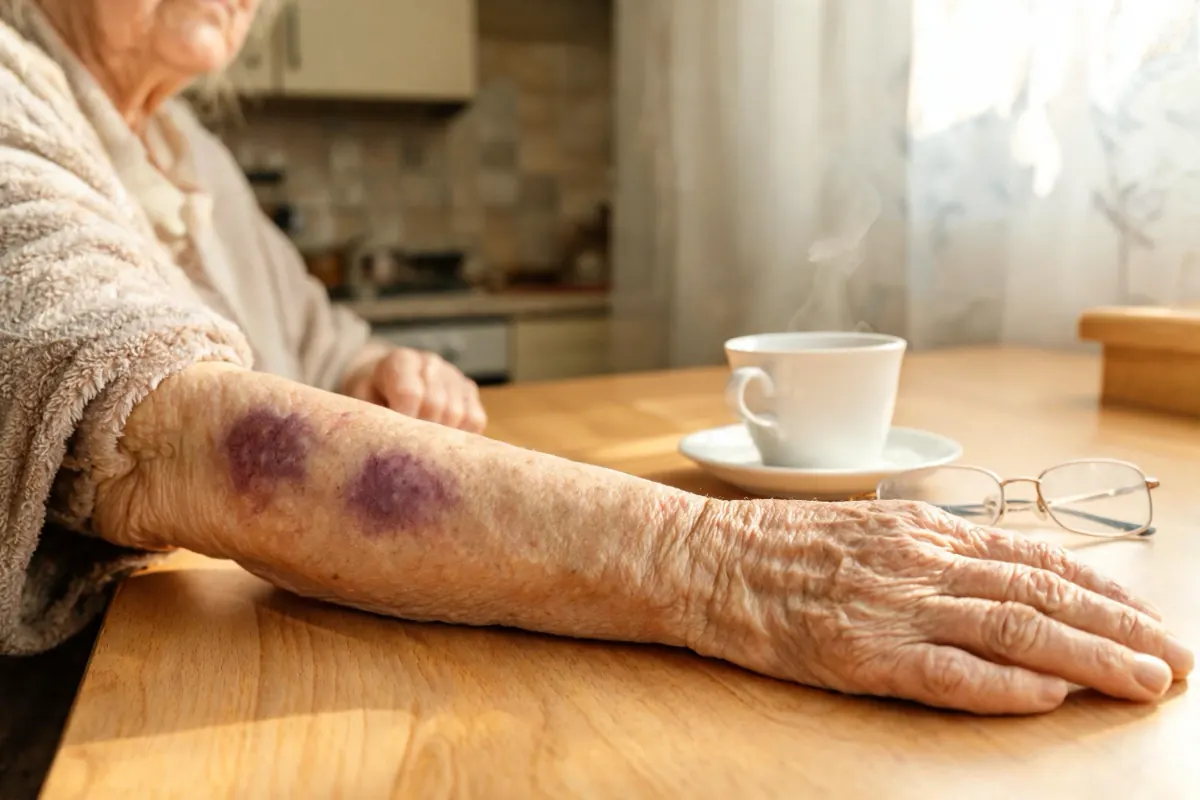
Seeing purple patches spread across your arms can feel alarming. The reassuring answer is that true senile purpura is harmless. The important part is making sure that's what it is.
What doctors say
DermNet, a dermatology reference written by dermatologists, describes senile purpura as benign and self-resolving, and unrelated to any systemic diseases or blood dyscrasias (blood disorders). Clotting tests are rarely needed and are typically normal [1]. MedlinePlus lists "fragile blood vessels seen in older people (senile purpura)" among the non-dangerous causes of purpura [2].
The problem is cosmetic and practical — not medical in itself.
The real risk: fragile skin
Senile purpura is a visible sign that the skin is thin and fragile. DermNet notes it is a risk factor for skin tears in people living in care facilities [1]. Skin tears are common: about 1 in 5 long-term care residents had one in a 2020 study [4]. So the best response to purpura is to protect the skin — see how to prevent skin tears.
What about blood thinners?
Blood thinners and aspirin make senile purpura patches more frequent and larger [6]. That doesn't make the purpura dangerous, and it's not a reason to stop the medicine. But it does mean that a head injury or heavy bleeding needs urgent attention.
8 red flags: when it might be something else
A doctor will usually look at the spots, ask about medicines, and may order a blood count and clotting tests if anything doesn't fit [5].
Quick self-check: does it fit senile purpura?
| Typical senile purpura | Doesn't fit — get checked |
|---|---|
| Forearms and backs of hands | Legs, trunk, mouth |
| Flat, sharp edges, 1–4 cm | Pinpoint dots or raised spots |
| Painless | Itchy, burning, painful |
| Thin, sun-damaged skin around it | Normal-looking skin |
| Fades over 1–3 weeks, may leave brown | Spreading or not fading |
| You feel well | Fever, tiredness, other bleeding |
What to do next
If your spots fit the typical pattern, the best next steps are practical: sun protection, twice-daily moisturizing and long sleeves. Our senile purpura treatment guide reviews what has evidence behind it.
Frequently asked questions
Can senile purpura turn into something serious?
No. Senile purpura doesn't develop into a blood disorder or other disease. It is a sign of fragile skin, which can tear more easily.
Should I see a doctor for senile purpura?
It's sensible to have it confirmed once, especially if you're unsure or it started suddenly. After that, see a doctor only if something changes or any red flag appears.
Is senile purpura a sign of low platelets?
No. In senile purpura, platelet counts and clotting tests are typically normal. Low platelets more often cause pinpoint petechiae and bleeding gums.
Can senile purpura cause skin tears?
The fragile skin behind senile purpura is a risk factor for skin tears. Moisturizing and protecting your arms reduces that risk.
Sources
- Senile purpura — DermNet (New Zealand).
- Purpura — MedlinePlus Medical Encyclopedia.
- Bleeding into the skin — MedlinePlus Medical Encyclopedia (U.S. National Library of Medicine).
- LeBlanc K, et al. Skin tear prevalence and incidence in the long-term care population: a prospective study. Journal of Wound Care, 2020. PubMed 32654616
- Ballas M, Kraut EH Bleeding and bruising: a diagnostic work-up. American Family Physician, 2008. PubMed 18481559
- Blood Thinners — MedlinePlus (U.S. National Library of Medicine).
General information, not medical advice. Written by the Reunoa editorial team; Reunoa makes Bruise Defense & Repair Serum. See our editorial policy for how we pick sources and keep product mentions fair.