Bruise color chart: what each color means
 By Margaret Hale, Reunoa EditorialLast updated
The short answer
Bruises usually change from red or purple (fresh) to blue-purple (days 1–5), green (days 5–10), yellow (days 7–14) and then fade; a lingering brown mark is often iron left in the skin. Color is only a rough guide — research shows it can't reliably tell a bruise's age, and some bruises in older adults turn yellow within a day. Very dark, growing or unexplained bruises need a check.
Pick the color you see for a short explanation, or use the full chart below. Free to use and share; nothing you select is stored.
The bruise color chart
| Color | Typical timing | What's happening | What helps |
|---|---|---|---|
| Red / pink | Hours to ~2 days | Fresh blood under the skin [3] | Wrapped cold pack 10–15 min, raise the limb |
| Dark purple / blue | ~Days 1–5 | Haemoglobin losing oxygen | Protect from knocks; gentle warmth after 48 h |
| Green | ~Days 5–10 | Haemoglobin → biliverdin [1] | Healing — keep protecting |
| Yellow / yellow-brown | ~Days 7–14+ | Biliverdin → bilirubin, being cleared | Nearly done |
| Brown that stays | Weeks–months | Iron stored as hemosiderin [4] | Sun protection; see a doctor for leg staining |
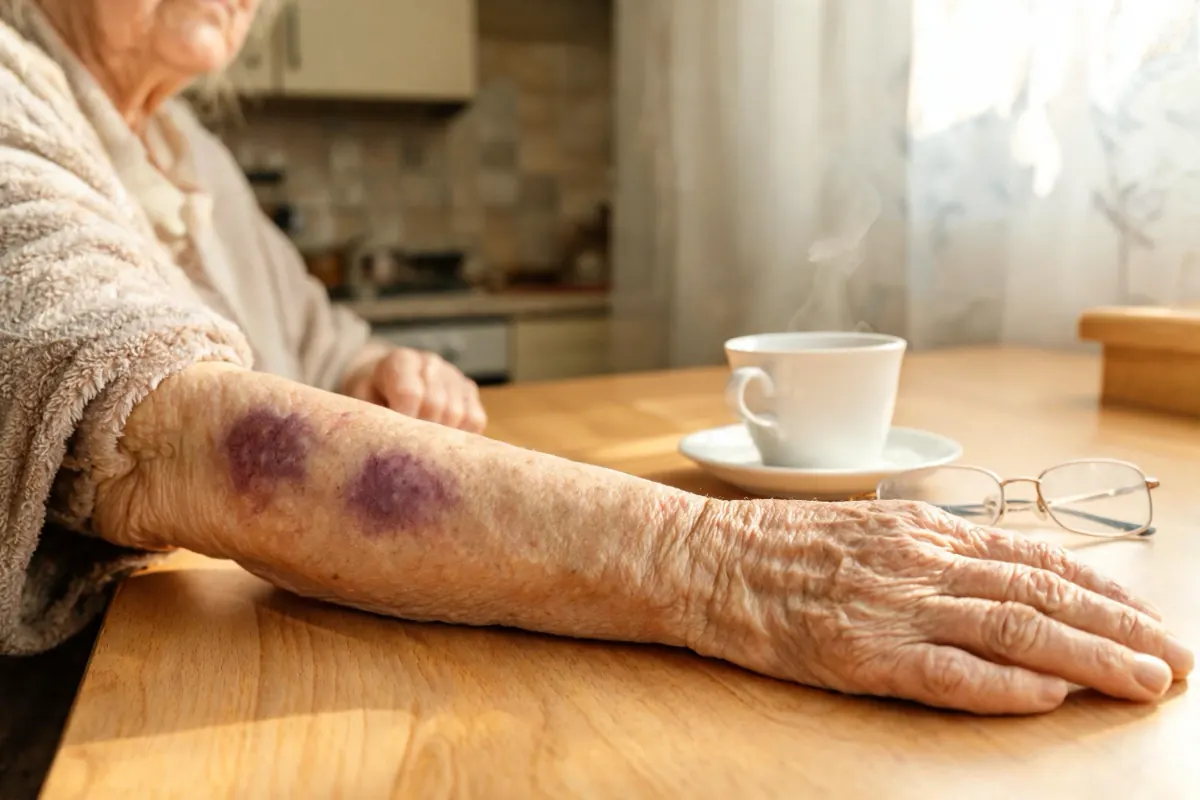
| Flat purple, sharp edges, forearm | Fades in 1–3 weeks | Likely senile (actinic) purpura [4] | Protect skin, moisturize, sunscreen |
Why color can't date a bruise
A review of research on estimating bruise age found that color is an unreliable guide [1]. In a study tracking bruises in older adults, some bruises were mostly yellow within the first 24 hours [2]. Depth, skin thickness, skin tone, location and medicines all change how a bruise looks. Use the chart as a general picture, not a clock.
Colors in older skin
- Senile purpura often skips the green-yellow phase: it stays purple and fades to brown [4].
- Blood thinners make bruises larger and longer-lasting.
- Lower-leg bruises clear more slowly and more often leave brown marks.
More: bruise color stages explained · how long does a bruise last?
Use this chart on your site
Care homes, home-care agencies and caregiver blogs are welcome to link to this chart. Please link to this page rather than copying the table, so readers always get the current version.
Frequently asked questions
What do the different colors of a bruise mean?
Red or purple means fresh; blue-purple is early; green and yellow mean the body is clearing the blood; lingering brown is often iron left in the skin.
What color is an old bruise?
Usually yellow or yellow-brown, sometimes with a lingering brown mark. But color can't reliably date a bruise.
Why is my bruise yellow already?
Some bruises turn yellow quickly, especially shallow ones. In older adults, yellow was seen within 24 hours in some bruises in a study.
When should a bruise color worry me?
When it's very dark and swollen, keeps spreading, doesn't change for weeks, or appears without a knock in unusual places.
Sources
- Langlois NE The science behind the quest to determine the age of bruises — a review of the English language literature. Forensic Science, Medicine and Pathology, 2007. PubMed 25869263
- Mosqueda L, Burnight K, Liao S The life cycle of bruises in older adults. Journal of the American Geriatrics Society, 2005. PubMed 16078959
- Bruise — MedlinePlus Medical Encyclopedia.
- Senile purpura — DermNet (New Zealand).
- Bleeding into the skin — MedlinePlus Medical Encyclopedia (U.S. National Library of Medicine).
General information, not medical advice. Written by the Reunoa editorial team; Reunoa makes Bruise Defense & Repair Serum. See our editorial policy for how we pick sources and keep product mentions fair.