Senile purpura vs a bruise: how to tell the difference
 By Margaret Hale, Reunoa EditorialLast updated
The short answer
Senile purpura is a type of bruise in fragile, sun-damaged skin, but it behaves differently: it appears after tiny knocks, is flat with sharp edges, is usually painless, stays purple instead of turning green and yellow, and fades over one to three weeks — often leaving a brown stain. An ordinary bruise follows a real bump, is tender and changes colour.
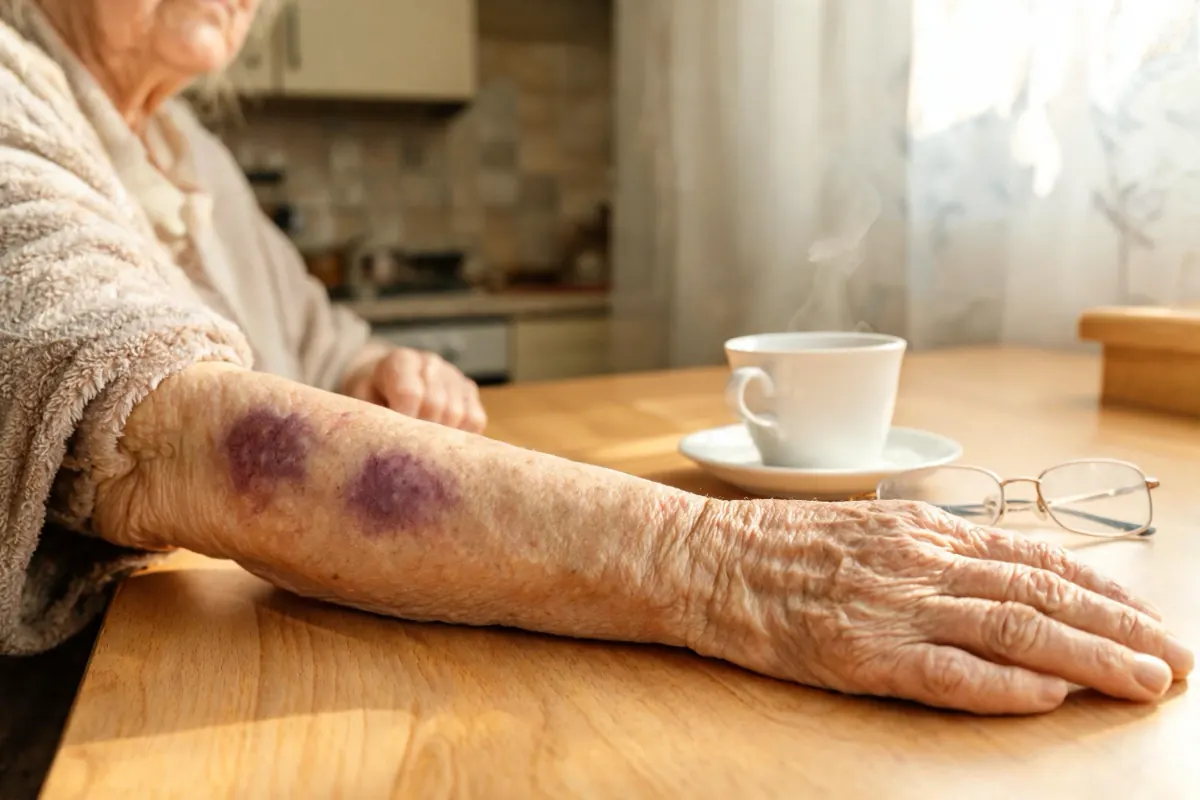
Both are blood that has leaked out of small vessels into the skin. Technically, senile purpura is a kind of bruise. But in daily life they look so different that it helps to know which one you're dealing with.
The 6 differences
| Senile purpura | Ordinary bruise | |
|---|---|---|
| 1. Cause | Very minor friction or knock — often none remembered | A noticeable bump or injury [2] |
| 2. Shape and feel | Flat, sharp irregular edges | Often raised or swollen at first, soft fading edges |
| 3. Pain | Usually painless | Tender or sore for a few days |
| 4. Colour change | Stays dark purple, then fades to brown [1] | Red-purple → blue → green → yellow → gone |
| 5. Location | Outer forearms and backs of hands | Anywhere you were hit |
| 6. Leftover | Brown stain common | Usually fades completely |
Why they behave differently
In senile purpura, the skin around the vessels has lost much of its collagen support because of age and sun damage. Vessels tear from forces that wouldn't affect younger skin, and blood spreads into a thin dermis, creating a flat patch with sharp edges. The body clears it more slowly, and iron from the blood often stays behind as a brown hemosiderin stain [1].
An ordinary bruise comes from a harder blow that damages tissue more deeply. The inflammation causes swelling and tenderness, and the familiar colour sequence comes from haemoglobin breaking down into biliverdin (green) and bilirubin (yellow) [2].
A caution about colour
Colour isn't a precise clock for either. A review of bruise-ageing research found colour is an unreliable way to tell how old a bruise is [4], and in older adults some bruises were mostly yellow within the first 24 hours [3]. Use colour as a rough guide only. More: bruise color stages.
Can you have both?
Yes — very often. Someone on a blood thinner with sun-damaged forearms may have senile purpura on their arms and ordinary bruises on their legs at the same time.
Why the difference matters
- Treatment: ice helps a fresh bruise in the first hours; for senile purpura, the focus is protecting fragile skin, sun protection and moisturizing.
- Peace of mind: senile purpura is benign; ordinary bruises without a cause in unusual places deserve more attention.
- Caregivers: knowing what senile purpura looks like helps avoid unnecessary alarm — and spot what doesn't fit.
Frequently asked questions
Is senile purpura just a bruise?
Technically it's a type of bruise in fragile skin. It looks and behaves differently: flat, sharp-edged, painless, and it stays purple before fading to brown.
Does senile purpura change colour like a bruise?
Not usually. It doesn't go through the green and yellow stages. It stays purple and fades, often leaving a brown mark.
Why do my bruises have sharp edges?
Sharp-edged, flat purple patches on the forearms are typical of senile (actinic) purpura, caused by thin, sun-damaged skin.
Which heals faster, a bruise or senile purpura?
A small ordinary bruise often fades in one to two weeks. Senile purpura patches take up to three weeks and may leave brown stains for longer.
Sources
- Senile purpura — DermNet (New Zealand).
- Bruise — MedlinePlus Medical Encyclopedia.
- Mosqueda L, Burnight K, Liao S The life cycle of bruises in older adults. Journal of the American Geriatrics Society, 2005. PubMed 16078959
- Langlois NE The science behind the quest to determine the age of bruises — a review of the English language literature. Forensic Science, Medicine and Pathology, 2007. PubMed 25869263
- Purpura — MedlinePlus Medical Encyclopedia.
General information, not medical advice. Written by the Reunoa editorial team; Reunoa makes Bruise Defense & Repair Serum. See our editorial policy for how we pick sources and keep product mentions fair.