Why do bruises leave brown spots — and how do you fade them?
 By Margaret Hale, Reunoa EditorialLast updated
The short answer
A brown spot after a bruise is usually hemosiderin — iron-storing pigment left behind as the body breaks down leaked blood. It's common in older, sun-damaged skin, after senile purpura and on the lower legs. Light spots often fade over weeks to months. Preventing new bruises in the same spot, sun protection and, for stubborn marks, lasers can help.
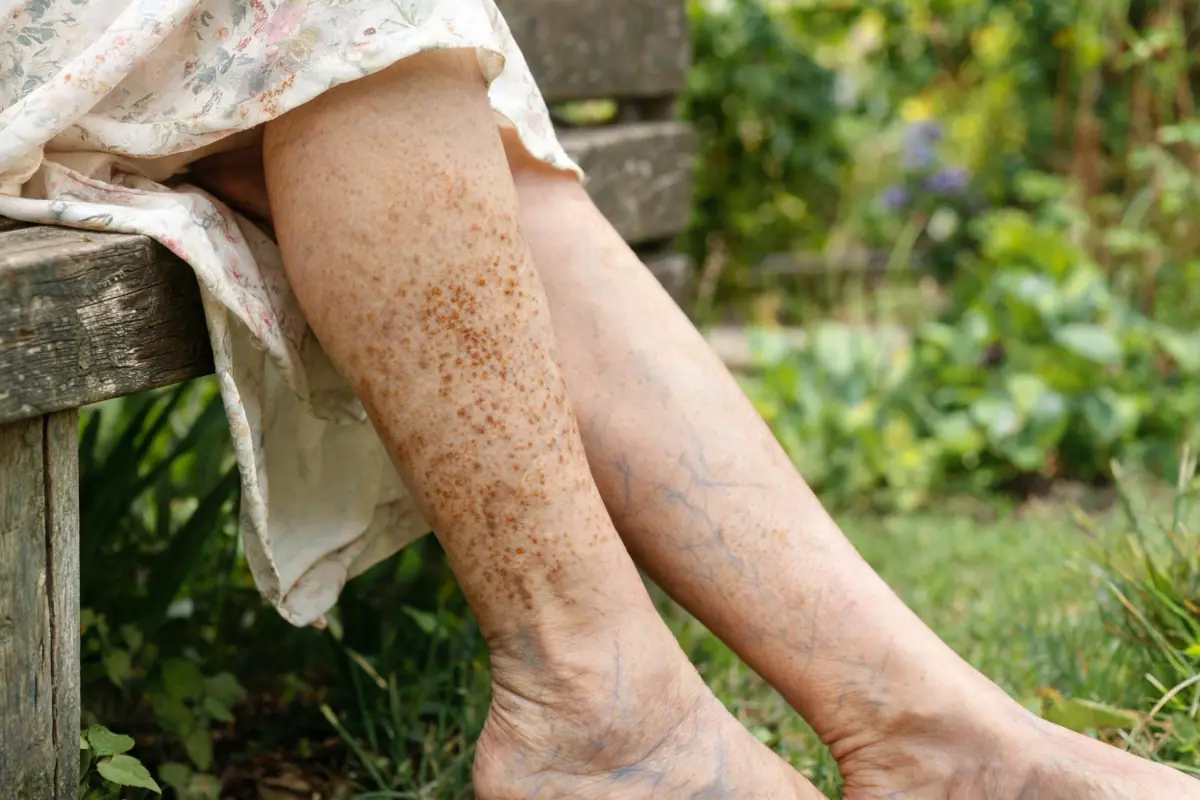
The bruise is gone, but a brown shadow remains. Weeks later, it's still there. This is one of the most common questions from people over 60.
Why bruises turn brown
When blood leaks under the skin, cleanup cells break down haemoglobin step by step: purple-blue, then green (biliverdin), then yellow (bilirubin) [3] [2]. The iron is stored in a protein called hemosiderin, which is brown. Usually it's cleared too. When it isn't cleared fully, a brown spot remains.
Why it happens more after 60
- Senile purpura — DermNet notes persistent brown pigmentation after the purple patches resolve comes from hemosiderin deposition [1].
- Slower cleanup in older skin.
- Repeated bruising in the same spot adds more iron.
- Sun darkens pigmented areas.
- On the lower legs, poor venous return slows clearance and adds new leakage [4].
Is it something else?
| Brown mark | Clues |
|---|---|
| Hemosiderin after bruise | Where a bruise was; rust-brown; fades slowly |
| Age spot (solar lentigo) | Not linked to bruising; tan, flat, sharp edges; on sun-exposed skin |
| Leg staining from veins | Ankles and shins; with swelling or varicose veins |
| Changing mole or spot | Irregular, growing, several colours — see a doctor |
How to help it fade
- Stop new bruises in that spot — sleeves, padding, moisturizer twice daily (halved skin tears in older adults [6]).
- Sun protection — sunscreen on forearms and hands.
- Be patient — light marks often fade over weeks to months.
- Lasers for stubborn marks — in a small study, 45% of long-standing hemosiderin stains lightened with pulsed dye laser [5].
- Skip harsh bleaching creams — they target melanin, not iron, and irritate thin skin.
More: does hemosiderin staining go away?
Practical tips while it fades
- Cover with makeup if you like: a peach-toned corrector followed by a body foundation hides brown marks well. See how to cover bruises on arms.
- Keep skin moisturized: dry, flaky skin makes brown marks look darker and duller.
- Avoid friction: tight watch straps, bag handles or repeated leaning on the same spot can cause new micro-bleeds.
- Check your medicines: if you bruise often in the same areas, ask your doctor or pharmacist whether any medicine or supplement adds to it — but never stop a blood thinner on your own.
When a brown spot isn't a bruise mark
If you can't link a brown spot to an earlier bruise, it's more likely an age spot, a seborrheic keratosis or a mole. Have any spot that is new, growing, irregular or changing checked by a dermatologist.
Frequently asked questions
Why is my bruise brown and not going away?
The brown is usually hemosiderin, iron left from broken-down blood. In older skin or with repeated bruising, it's cleared slowly.
How long do brown marks from bruises last?
Often weeks to a few months; longer after repeated bruising in the same area or on the lower legs.
Can a bruise leave a permanent mark?
Occasionally, especially after many bruises in the same spot or with vein disease. Lasers can lighten some persistent marks.
Is a brown bruise healing?
Yes, brown and yellow are late stages of healing. If a brown mark persists for months, it is likely hemosiderin staining.
Sources
- Senile purpura — DermNet (New Zealand).
- Langlois NE The science behind the quest to determine the age of bruises — a review of the English language literature. Forensic Science, Medicine and Pathology, 2007. PubMed 25869263
- Bruise — MedlinePlus Medical Encyclopedia.
- Venous insufficiency — MedlinePlus Medical Encyclopedia.
- Goldman MP Postsclerotherapy hyperpigmentation. Treatment with a flashlamp-excited pulsed dye laser. Journal of Dermatologic Surgery and Oncology, 1992. PubMed 1607465
- Carville K, et al. The effectiveness of a twice-daily skin-moisturising regimen for reducing the incidence of skin tears. International Wound Journal, 2014. PubMed 25040325
General information, not medical advice. Written by the Reunoa editorial team; Reunoa makes Bruise Defense & Repair Serum. See our editorial policy for how we pick sources and keep product mentions fair.