How to stop bruising on blood thinners — without touching your dose
 By Margaret Hale, Reunoa EditorialLast updated
The short answer
You can't stop all bruising on blood thinners — it shows the medicine is working — but you can cut down new bruises. Ask for a medicine and supplement review, avoid NSAIDs unless approved, moisturize forearms twice daily, wear sleeves and pad sharp corners, use a cold pack right after knocks, and consider topical products on unbroken skin. Never change your dose yourself.
Key takeaways
- Bruising is expected on blood thinners; stopping them raises stroke and clot risk [1] [2].
- NSAIDs like ibuprofen add to bleeding risk with anticoagulants [1].
- Twice-daily moisturizing cut skin tears by almost half in older adults — the same fragile skin that bruises [5].
- Ice in the first hours may limit swelling; evidence for bruises specifically is limited [6].
- 20% topical arnica helped bruises fade faster than placebo in a trial [7].
On this page
If you take Eliquis, Xarelto, warfarin, Plavix or daily aspirin, you've probably been told bruising is "normal". It is — but that doesn't mean you have to accept arms covered in purple. Here are 12 steps that reduce bruising safely, sorted from "talk to your doctor" to "do it tonight".
First: what you must not do
- Don't stop, skip or halve your blood thinner because of bruises. Stopping raises the risk of stroke and blood clots [1] [2].
- Don't take extra aspirin or ibuprofen for pain without checking.
- Don't start supplements "to strengthen blood vessels" without asking your pharmacist.
Part 1 — Medicines (with your doctor or pharmacist)
1. Ask for a medication review
Bring every medicine and supplement — including over-the-counter pain relievers and vitamins — to your doctor or pharmacist once a year. Sometimes an old prescription (like aspirin started years ago "for the heart") is no longer needed alongside an anticoagulant [4].
2. Avoid NSAIDs unless approved
Ibuprofen, naproxen and similar drugs increase bleeding risk with anticoagulants [1]. Ask about alternatives — acetaminophen is often suggested — for headaches and joint pain.
3. Check supplements
High-dose fish oil, vitamin E, ginkgo, garlic and turmeric pills are commonly flagged for bleeding. Ask which ones you really need. See fish oil and bruising.
4. On warfarin: keep your INR in range
Sudden new bruising can mean your INR is too high. Keep tests, tell the clinic about antibiotics, and keep vitamin K foods consistent [3]. More: warfarin bruising.
Part 2 — A skin care routine for blood thinner users
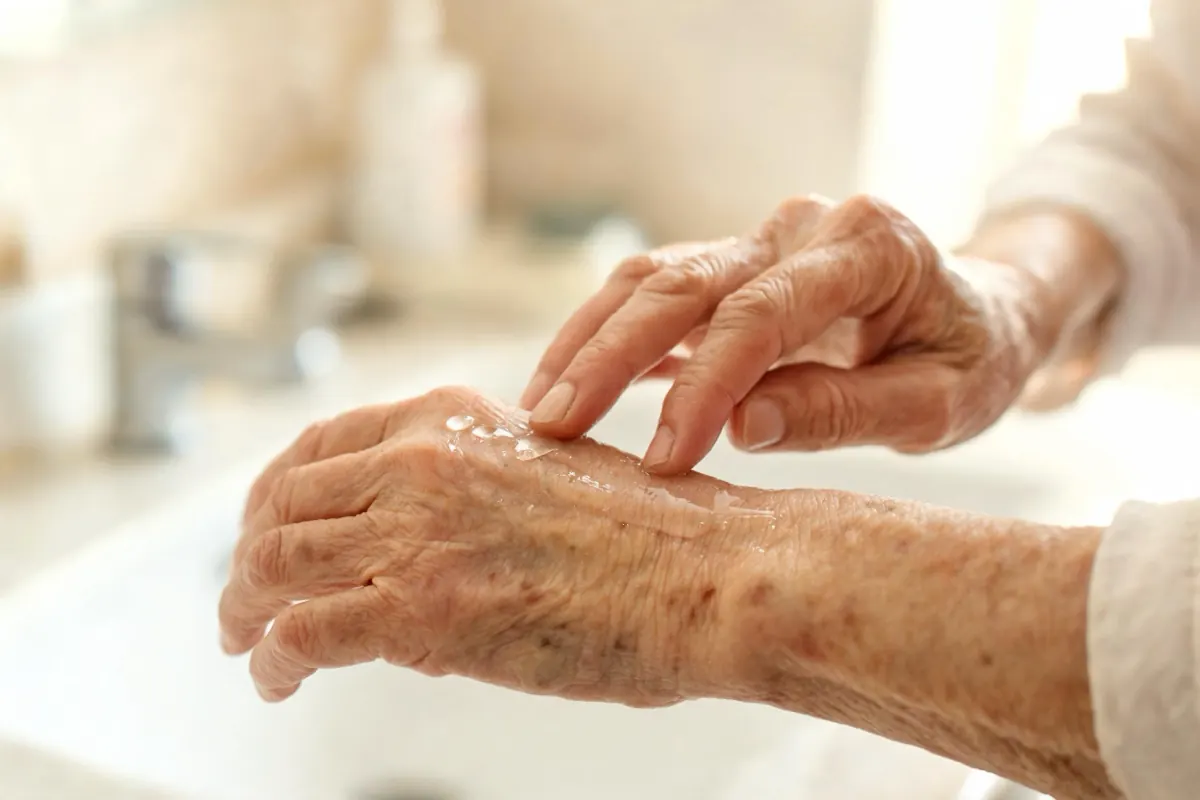
Thin, dry skin bruises and tears more easily [10]. Supporting the skin barrier is the part you control fully.
5. Moisturize twice a day
Morning and evening, on forearms, hands and shins. In a randomized trial in aged-care homes, a twice-daily moisturizer on the limbs cut skin tears by almost half [5]. Choose fragrance-free products; ceramide-containing creams support the barrier [9].
6. Use gentle cleansing
Lukewarm water, soap-free cleanser, pat dry. Hot showers and harsh soaps dry fragile skin further.
7. Protect from the sun
Sun damage weakens the skin and small vessels on forearms and hands — the classic site of senile purpura. Use sunscreen and long sleeves outdoors.
8. Consider a targeted topical product
Products for bruise-prone skin act on the skin, not in the blood, and don't change how your anticoagulant works. Evidence for key ingredients:
- Arnica (high strength): 20% arnica ointment sped bruise fading versus placebo [7].
- Vitamin K: reduced bruise severity after laser treatment [8] — but on warfarin, ask your clinic first (why).
- Ceramides: support the skin barrier [9].
Use on unbroken skin only. Check is arnica safe with blood thinners?
Part 3 — Fewer bumps
9. Cover your arms
Light long sleeves for gardening, housework, carrying boxes and with pets. Padded sleeves help if you knock your forearms often.
10. Make the home bump-proof
Pad sharp table corners and bed frames, clear walkways, add night lights, move often-used items to waist height.
Part 4 — After a knock
11. Cold and raise, early
Wrap a cold pack in cloth and apply for 10–15 minutes, and raise the limb. Ice can reduce swelling in soft-tissue injuries; evidence specifically for bruises is limited [6]. Never put ice directly on thin skin.
12. Know when it's not "just a bruise"
A simple weekly plan
| Day | Action |
|---|---|
| Every day | Moisturize morning and evening; long sleeves for chores |
| Once | Pad the two or three corners you bump most |
| Before next appointment | List all medicines and supplements; note bruise sizes for two weeks |
| After any knock | Wrapped cold pack 10–15 min, raise the limb |
Frequently asked questions
Can you stop bruising on blood thinners?
Not completely — bruising shows the medicine is working. But reviewing medicines and supplements, protecting the skin, moisturizing and avoiding bumps can reduce new bruises noticeably.
What is the best skin care for people on blood thinners?
Gentle cleansing, twice-daily fragrance-free moisturizer on arms and legs, sun protection and long sleeves. Barrier ingredients like ceramides and bruise-focused ingredients like arnica can be added on unbroken skin.
Which supplements help prevent bruising on blood thinners?
None should be started without your doctor or pharmacist. Some, like high-dose fish oil or vitamin E, can add to bleeding. Vitamin K supplements interfere with warfarin.
How long do bruises last on blood thinners?
Often two to three weeks, sometimes longer on thin forearm skin. Brown marks can remain after the purple fades.
Should I ask my doctor to lower my blood thinner dose?
You can raise the topic, but bruising alone is rarely a reason. Doctors set doses based on kidney function, age, weight and stroke or clot risk.
Sources
- Apixaban — Drug Information — MedlinePlus.
- Rivaroxaban — Drug Information — MedlinePlus.
- Warfarin — Drug Information — MedlinePlus.
- Blood Thinners — MedlinePlus (U.S. National Library of Medicine).
- Carville K, et al. The effectiveness of a twice-daily skin-moisturising regimen for reducing the incidence of skin tears. International Wound Journal, 2014. PubMed 25040325
- Bleakley C, et al. The use of ice in the treatment of acute soft-tissue injury: a systematic review of randomized controlled trials. American Journal of Sports Medicine, 2004. PubMed 14754753
- Leu S, et al. Accelerated resolution of laser-induced bruising with topical 20% arnica: a rater-blinded randomized controlled trial. British Journal of Dermatology, 2010. PubMed 20412090
- Shah NS, et al. The effects of topical vitamin K on bruising after laser treatment. Journal of the American Academy of Dermatology, 2002. PubMed 12140470
- Andrew PV, et al. Topical supplementation with physiological lipids rebalances the stratum corneum ceramide profile and strengthens skin barrier function. British Journal of Dermatology, 2025. PubMed 40408261
- Aging changes in skin — MedlinePlus Medical Encyclopedia.
- Bleeding into the skin — MedlinePlus Medical Encyclopedia (U.S. National Library of Medicine).
General information, not medical advice. Written by the Reunoa editorial team; Reunoa makes Bruise Defense & Repair Serum. See our editorial policy for how we pick sources and keep product mentions fair.