Bruising on warfarin: what your INR, diet and other medicines have to do with it
 By Margaret Hale, Reunoa EditorialLast updated
The short answer
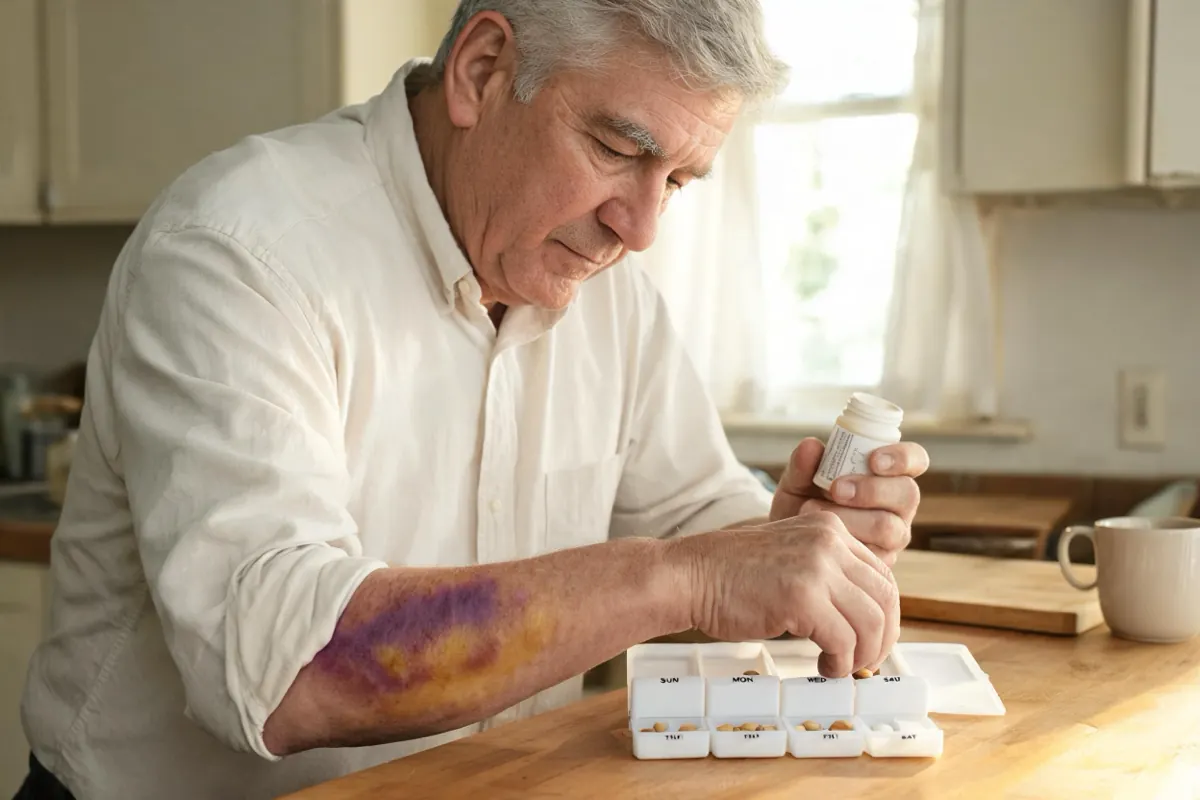
Easy bruising is a known side effect of warfarin. Small bruises on the arms and legs are common, but a sudden increase in bruising can mean your INR has climbed too high — for example after a new antibiotic, less vitamin K in your diet or a missed check. Call your anticoagulation clinic for an INR test, and never change your dose on your own.
Key takeaways
- Warfarin lists easy bruising among side effects that need attention; it may cause serious bleeding [1].
- New or heavier bruising can be a sign that your INR is too high — ask for a test [2].
- Warfarin works against vitamin K, so keep vitamin K foods steady from week to week [1] [4].
- Many medicines interact: antibiotics, NSAIDs, some statins and supplements can raise the INR [1] [5].
- Newer anticoagulants cause less brain bleeding than warfarin, but switching is a doctor's decision [6].
On this page
Warfarin has been used for more than half a century and still protects millions of people with mechanical heart valves, atrial fibrillation and blood clots. It's also the blood thinner most sensitive to change — which is why bruising on warfarin is a useful signal worth paying attention to.
Why warfarin causes bruising
Warfarin reduces the liver's ability to use vitamin K to make clotting factors. Blood takes longer to clot, so a knock that would leave nothing in a younger person leaves a bruise on thin, older skin [9]. MedlinePlus lists easy bruising among the side effects to report, and warns that warfarin can cause serious bleeding [1].
Your INR: the number behind the bruises
The INR (international normalized ratio) measures how long your blood takes to clot. Your clinic sets a personal target range — for many conditions it is around 2 to 3. If your INR rises above your range, bleeding and bruising increase [2].
Things that commonly push the INR up:
- starting a new antibiotic or antifungal
- eating noticeably fewer green vegetables than usual
- illness, diarrhoea or not eating
- more alcohol than usual
- certain supplements (e.g. high-dose fish oil, vitamin E, ginkgo, cranberry products in large amounts)
- some other medicines, including certain statins in some patients [5]
Sudden new bruising on warfarin = ask for an INR check. Don't skip or double doses to "fix" it yourself.
Vitamin K: keep it steady, don't avoid it
Many people think they must avoid green vegetables on warfarin. The real rule is consistency: eat roughly the same amount of vitamin K-rich foods (spinach, kale, broccoli, Brussels sprouts) each week, so the dose can be set around it [1]. MedlinePlus also advises against suddenly eating large amounts of leafy greens. In a study of people on long-term warfarin, stable vitamin K intake was linked to more stable anticoagulation [4].
What about vitamin K creams? See vitamin K cream and warfarin.
Normal vs warning signs
| Usually normal | Call your clinic or doctor |
|---|---|
| A few small bruises on arms and legs | Many new bruises in a short time |
| Bruises that fade over 2–3 weeks | Large bruises without a knock |
| Minor cuts bleeding a little longer | Nosebleeds, bleeding gums, heavy periods |
| Flat purple patches on sun-aged forearms | Pink, red or dark brown urine; red or black stools |
Is warfarin worse for bruising than Eliquis or Xarelto?
For serious bleeding, the newer drugs generally do better: in the ARISTOTLE trial, major bleeding was 2.13% per year on apixaban vs 3.09% on warfarin [7], and a 2022 meta-analysis found less bleeding in the brain with DOACs overall [6]. But warfarin remains the right choice for some people — including those with mechanical heart valves. Any switch is your doctor's decision.
Habits that help
- Keep your INR appointments [3] and tell the clinic about every new medicine, antibiotic or supplement.
- Ask your pharmacist before any pain reliever. NSAIDs such as ibuprofen and naproxen raise bleeding risk; acetaminophen is often the suggested alternative, but check first.
- Keep vitamin K foods consistent.
- Protect your skin: moisturize forearms twice a day, wear long sleeves for gardening, pad sharp corners.
- After a bump: wrapped cold pack 10–15 minutes, raise the limb.
More steps: how to stop bruising on blood thinners.
Frequently asked questions
Is bruising normal on warfarin?
Some easy bruising is normal. Sudden new or heavier bruising can mean your INR is too high — call your anticoagulation clinic for a check.
What INR level causes bruising?
Bruising can occur at any therapeutic INR, but it becomes more likely when the INR is above your target range. Your clinic will tell you your personal range.
Do I have to stop eating green vegetables on warfarin?
No. Keep your intake of vitamin K-rich foods consistent from week to week so your dose can be set around it. Sudden big changes are what cause problems.
Can antibiotics cause bruising on warfarin?
Yes, many antibiotics can raise the INR. Tell your anticoagulation clinic whenever you start one so they can check your INR.
What pain reliever is safe with warfarin?
NSAIDs like ibuprofen and naproxen increase bleeding risk. Acetaminophen is often suggested instead, but ask your doctor or pharmacist before taking any pain reliever.
Sources
- Warfarin — Drug Information — MedlinePlus.
- Warfarin — NHS (UK National Health Service).
- Taking warfarin (what to ask your doctor) — MedlinePlus Medical Encyclopedia.
- Kim KH, et al. Relationship between dietary vitamin K intake and the stability of anticoagulation effect in patients taking long-term warfarin. Thrombosis and Haemostasis, 2010. PubMed 20664899
- Andrus MR Oral anticoagulant drug interactions with statins: case report of fluvastatin and review of the literature. Pharmacotherapy, 2004. PubMed 14998226
- Carnicelli AP, et al. Direct Oral Anticoagulants Versus Warfarin in Patients With Atrial Fibrillation: Patient-Level Network Meta-Analyses of Randomized Clinical Trials. Circulation, 2022. PubMed 34985309
- Granger CB, et al. Apixaban versus warfarin in patients with atrial fibrillation (ARISTOTLE). New England Journal of Medicine, 2011. PubMed 21870978
- Bleeding into the skin — MedlinePlus Medical Encyclopedia (U.S. National Library of Medicine).
- Aging changes in skin — MedlinePlus Medical Encyclopedia.
General information, not medical advice. Written by the Reunoa editorial team; Reunoa makes Bruise Defense & Repair Serum. See our editorial policy for how we pick sources and keep product mentions fair.