Plavix (clopidogrel) bruising: why it happens and what you can do
 By Margaret Hale, Reunoa EditorialLast updated
The short answer
Yes, Plavix (clopidogrel) commonly makes you bruise more easily, because it stops platelets from sticking together to plug tiny leaks. Bruising is more noticeable when it is combined with aspirin after a stent or heart attack. Small bruises are expected. Don't stop Plavix without your cardiologist — stopping early after a stent can cause a dangerous clot.
Key takeaways
- The NHS lists nosebleeds, bruising more easily and bleeding that takes longer to stop as Plavix side effects [1].
- In the CURE trial, clopidogrel plus aspirin reduced heart attacks, strokes and cardiovascular deaths but increased major bleeding (3.7% vs 2.7%) [3].
- Stopping clopidogrel early — especially after a stent — can lead to a heart attack; always ask your cardiologist [2].
- NSAIDs such as ibuprofen raise bleeding risk with clopidogrel; paracetamol (acetaminophen) can be taken with it [1].
- Moisturizing, sleeves and padding reduce the bumps that turn into bruises.
On this page
Clopidogrel — best known as Plavix — is an antiplatelet medicine. It's prescribed after heart attacks, strokes and, very often, after a stent is placed in a heart artery. Many people take it together with low-dose aspirin for months. And many notice bruises they can't explain.
Why Plavix causes bruising
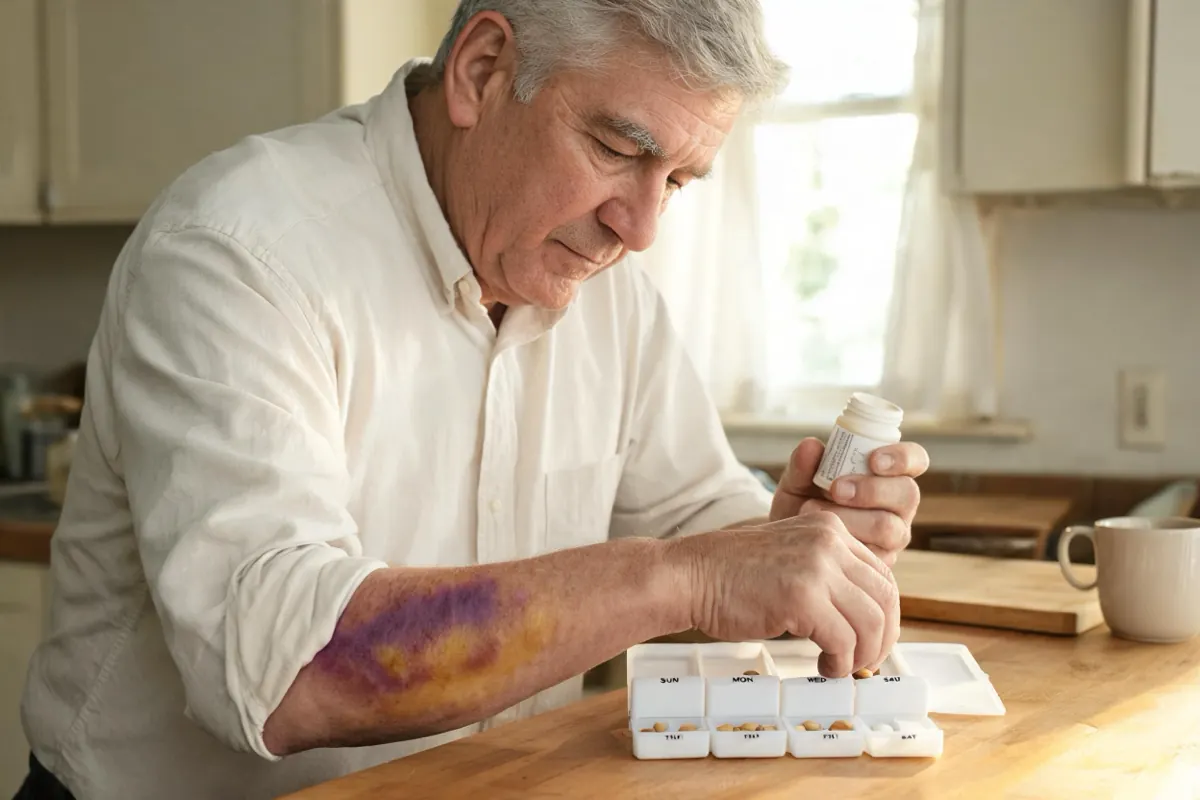
Platelets are tiny blood cells that clump together to plug a broken vessel. Clopidogrel blocks a receptor platelets need to stick together, and the effect lasts for the life of each platelet. Small leaks under the skin stay open longer, so bruises appear from smaller knocks and are larger [2]. On thin, sun-aged forearm skin [5] this is especially visible.
The NHS lists bleeding problems such as nosebleeds, bruising more easily, heavier periods and bleeding that takes longer to stop as Plavix side effects [1].
Plavix plus aspirin: more bruising, for a reason
After a stent or heart attack, doctors often prescribe "dual antiplatelet therapy" — clopidogrel plus aspirin. In the landmark CURE trial (more than 12,000 people with acute coronary syndromes), adding clopidogrel to aspirin cut the combined rate of cardiovascular death, heart attack and stroke from 11.4% to 9.3%. The price was more major bleeding: 3.7% vs 2.7%, while life-threatening bleeding was not significantly different [3].
Translation: if you're on both, expect more bruises. The combination is usually time-limited — your cardiologist will tell you how long.
Normal vs warning signs
| Usually normal | Get medical advice |
|---|---|
| Bruises on arms and legs from small bumps | Large bruises without a knock |
| Bruises that take a couple of weeks to fade | Nosebleeds or gum bleeding that won't stop |
| Small cuts bleeding longer | Pink/brown urine, black or bloody stools |
| Purple patches on forearms | Pinpoint red spots, fever, confusion or tiredness (rare blood disorder — urgent) |
Don't stop Plavix early
This is the most important point on this page. Stopping clopidogrel early, especially within the first months after a stent, can cause the stent to clot and lead to a heart attack [2]. Even before dental or other surgery, only stop if your cardiologist agrees. If bruising bothers you, tell your doctor; there may be options, but that decision belongs to them.
What adds to Plavix bruising
- NSAIDs like ibuprofen and naproxen — don't take them with clopidogrel unless a doctor has said it's OK; paracetamol (acetaminophen) can be taken with clopidogrel [1]
- Other blood thinners, unless specifically prescribed together
- Some antidepressants (SSRIs/SNRIs)
- Supplements such as high-dose fish oil, vitamin E, ginkgo — tell your pharmacist
- Omeprazole and esomeprazole don't cause bruising, but they can reduce how well clopidogrel works; your doctor may choose a different stomach medicine [1]
Skin habits that help
- Moisturize forearms and hands twice a day.
- Wear light long sleeves for gardening, DIY and with pets.
- Pad sharp edges at home and keep floors clear.
- After a bump, a wrapped cold pack for 10–15 minutes.
- Topical bruise products on unbroken skin work locally and don't change how clopidogrel works. High-strength 20% arnica helped bruises fade faster than placebo in a randomized trial [7].
More: how to stop bruising on blood thinners · does aspirin cause bruising?
Frequently asked questions
Does Plavix cause bruising?
Yes. Bruising more easily is a common side effect of clopidogrel. It is more noticeable when taken with aspirin.
How long does Plavix bruising last after stopping?
Clopidogrel's effect lasts for the life of the platelets it has affected — roughly a week to ten days — so bruising tendency fades gradually after stopping. Only stop if your doctor tells you to.
Can I take ibuprofen with Plavix?
Not unless a doctor says it's OK, because it increases the risk of bleeding. Paracetamol (acetaminophen) can be taken with clopidogrel.
Is it normal to bruise on Plavix and aspirin together?
Yes, more bruising is expected on dual antiplatelet therapy. Report large unexplained bruises or any other bleeding to your doctor.
What can I put on Plavix bruises?
A wrapped cold pack in the first day, then gentle moisturizer. Topical arnica, vitamin K or ceramide products on unbroken skin act locally and don't affect clopidogrel.
Sources
- Clopidogrel — NHS.
- Clopidogrel — Drug Information — MedlinePlus.
- Yusuf S, et al. Effects of clopidogrel in addition to aspirin in patients with acute coronary syndromes without ST-segment elevation (CURE). New England Journal of Medicine, 2001. PubMed 11519503
- Bleeding into the skin — MedlinePlus Medical Encyclopedia (U.S. National Library of Medicine).
- Aging changes in skin — MedlinePlus Medical Encyclopedia.
- Blood Thinners — MedlinePlus (U.S. National Library of Medicine).
- Leu S, et al. Accelerated resolution of laser-induced bruising with topical 20% arnica: a rater-blinded randomized controlled trial. British Journal of Dermatology, 2010. PubMed 20412090
General information, not medical advice. Written by the Reunoa editorial team; Reunoa makes Bruise Defense & Repair Serum. See our editorial policy for how we pick sources and keep product mentions fair.