Senile purpura on the hands: why it happens and what helps
 By Margaret Hale, Reunoa EditorialLast updated
The short answer
Senile purpura often appears on the backs of the hands because that skin is thin, has little padding over bones and tendons, and has had decades of sun exposure. Small knocks, rings or even tight grips cause flat purple patches that fade over one to three weeks. Sunscreen, moisturizer, gloves for chores and gentle handling help.
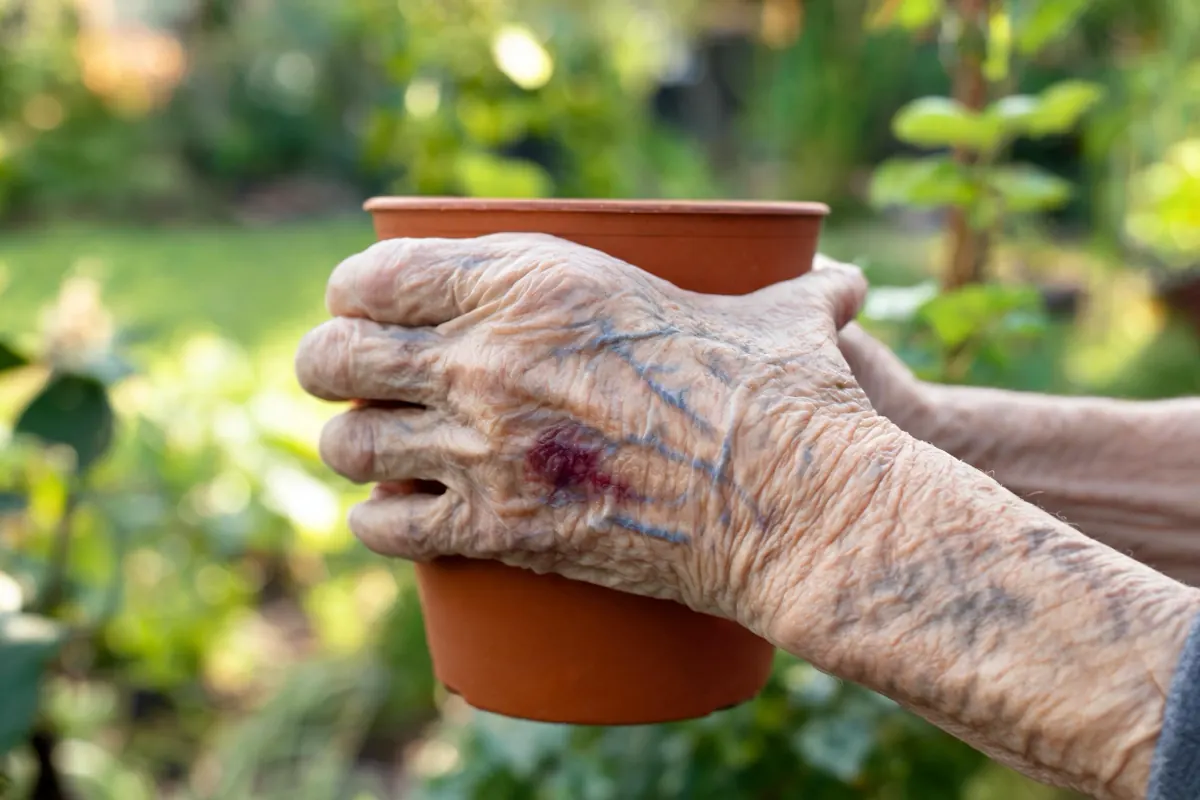
After the forearms, the backs of the hands are the most common place for senile purpura [1]. It's also where people notice it most — every time they reach for a cup or shake someone's hand.
Why the hands?
- Sun exposure: hands get sun almost every day of your life — driving, gardening, walking. UV light breaks down collagen that supports small blood vessels [2].
- Thin skin, little padding: there's hardly any fat between the skin and the bones and tendons on the back of the hand.
- Constant contact: hands bump into cupboard edges, car doors, grab rails and pets more than any other body part.
- Rings, watches, bag handles: pressure and friction concentrate on small areas.
What it looks like on the hands
Flat, dark-purple patches with sharp edges, often between the knuckles and the wrist. The skin around them is usually thin and crinkled, with visible veins and age spots. Patches fade over one to three weeks and may leave a brown mark [1].
What helps
- Sunscreen on the backs of your hands every morning — and reapply after washing. It's easy to forget.
- Moisturize after every hand wash or at least twice a day. Twice-daily moisturizing of the limbs cut skin tears by almost half in older adults [3].
- Gloves for gardening, cleaning and carrying boxes.
- Ask helpers to hold your forearm, not your hand or wrist, when assisting you.
- Remove rings with sharp settings for housework.
- Topical ingredients such as high-strength arnica [4] and vitamin K [5] helped bruises fade faster in controlled studies; a serum or cream that absorbs quickly is easier to use on hands.
More on hand skin: thin skin on hands and why do my hands bruise so easily?
Hands vs forearms: what's different
The backs of the hands have even less padding than the forearms, and you wash them many times a day, which strips oils and dries the skin. That's why hand skin often looks more crinkled and "see-through", with veins and tendons clearly visible. Two practical consequences:
- Moisturizer wears off quickly. Keep a small pump bottle by the sink and in your bag, and reapply after washing.
- Sunscreen wears off too. Hands are often forgotten when applying sunscreen and are washed frequently. Reapply at midday if you're outdoors.
A simple daily hand routine
| When | What |
|---|---|
| Morning | Moisturizer, then sunscreen on the backs of hands |
| After washing | Pat dry, small amount of moisturizer |
| Chores and gardening | Cotton-lined gloves |
| Evening | Targeted serum or richer cream; let it absorb before bed |
Frequently asked questions
Why do I get purple blotches on the back of my hands?
Usually senile purpura: thin, sun-damaged skin with fragile vessels that break after very minor knocks. Blood thinners and steroids make it more common.
Is senile purpura on the hands dangerous?
No. It is benign. It does show the skin is fragile, so protecting your hands from knocks and sun is worthwhile.
How do I cover purple spots on my hands?
Lightweight gloves for outings, or a colour-correcting concealer with a yellow or peach tone under your usual foundation. Make sure skin is intact and remove makeup gently.
Will the spots on my hands go away?
Each patch fades over one to three weeks. New patches may appear, but sun protection and moisturizing can reduce them.
Sources
- Senile purpura — DermNet (New Zealand).
- Rittié L, Fisher GJ Natural and sun-induced aging of human skin. Cold Spring Harbor Perspectives in Medicine, 2015. PubMed 25561721
- Carville K, et al. The effectiveness of a twice-daily skin-moisturising regimen for reducing the incidence of skin tears. International Wound Journal, 2014. PubMed 25040325
- Leu S, et al. Accelerated resolution of laser-induced bruising with topical 20% arnica: a rater-blinded randomized controlled trial. British Journal of Dermatology, 2010. PubMed 20412090
- Shah NS, et al. The effects of topical vitamin K on bruising after laser treatment. Journal of the American Academy of Dermatology, 2002. PubMed 12140470
- Purpura — MedlinePlus Medical Encyclopedia.
General information, not medical advice. Written by the Reunoa editorial team; Reunoa makes Bruise Defense & Repair Serum. See our editorial policy for how we pick sources and keep product mentions fair.