Can a steroid inhaler cause bruising?
 By Margaret Hale, Reunoa EditorialLast updated
The short answer
Yes, steroid inhalers can contribute to easy bruising. In the Lung Health Study II, 11.2% of people with COPD who regularly used an inhaled steroid reported easy bruising, compared with 3.5% on placebo; older men with good inhaler adherence seemed most affected. Keep using your inhaler as prescribed, and ask your doctor whether your dose is right for you.
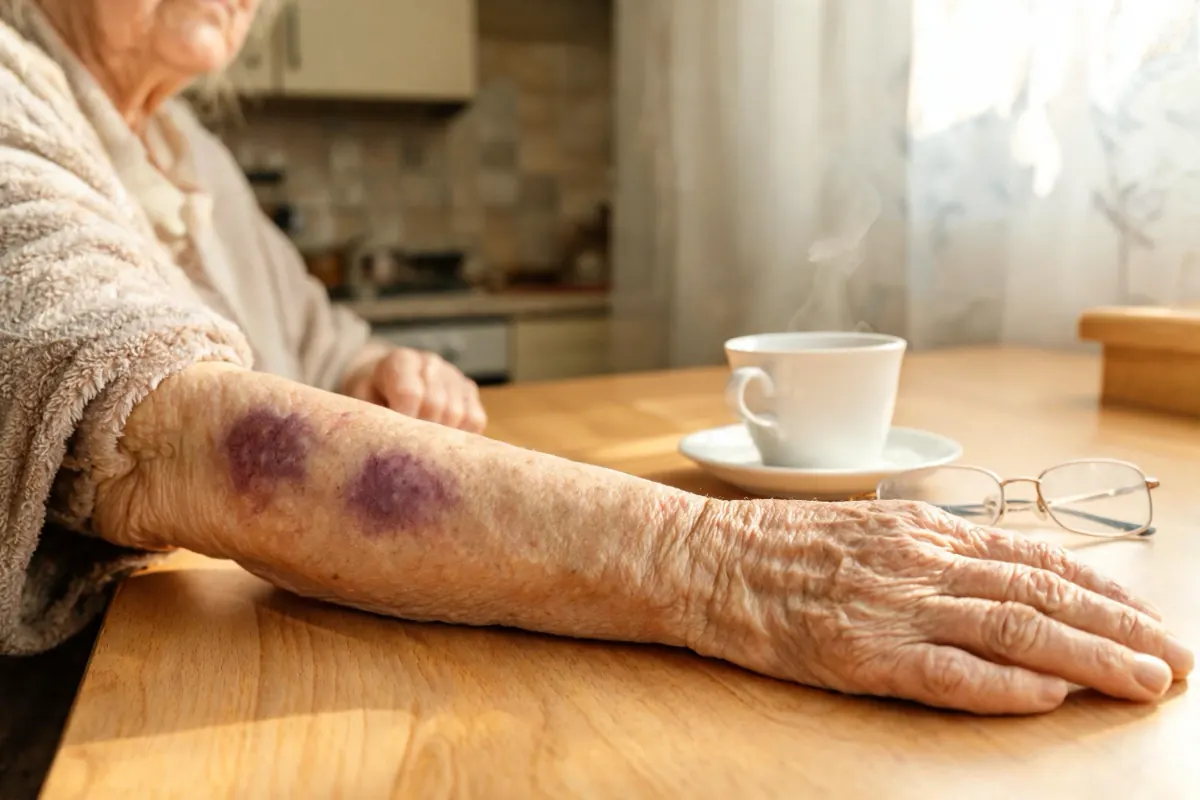
Steroid inhalers (inhaled corticosteroids, ICS) such as fluticasone, budesonide, beclomethasone and mometasone are cornerstones of asthma and COPD treatment. Most of the medicine stays in the lungs, but a small amount is absorbed into the body — enough, over years, to affect the skin in some people.
What the research shows
The clearest data comes from the Lung Health Study II, a randomized trial in people with COPD. Every six months, participants were asked about skin changes [1]:
- Easy bruising: 11.2% with the inhaled steroid vs 3.5% with placebo (among those who used their inhaler consistently)
- Slow healing of cuts or sores: 2.4% vs 0.5%
- Older men with good adherence appeared to be at the highest risk
So, most people on steroid inhalers do not notice extra bruising — but it is roughly three times as common as without.
Who is more at risk
- higher doses, especially of the more potent inhaled steroids
- years of use
- older age and sun-damaged, thin skin
- also taking steroid tablets for flares [2]
- also taking blood thinners or aspirin
Should you stop your inhaler?
No. Inhaled steroids prevent flare-ups and hospital stays. Stopping them can be risky. Instead, ask your doctor or respiratory nurse:
- Is my dose the lowest that keeps my symptoms controlled?
- Is my inhaler technique right? (Better technique means more goes to the lungs.)
- Would a spacer help?
- Do I still need the steroid component, or would another option suit me?
Protecting your skin
- Moisturize forearms and hands twice a day — it halved skin tears in older adults in a trial [4].
- Long sleeves for chores and gardening.
- Sunscreen on forearms and hands.
- Pad corners at home.
- Rinse your mouth after each dose (this helps prevent thrush; it doesn't affect skin).
Steroid-related skin thinning is mostly linked to chronic, long-term exposure [3]. More: steroid skin thinning.
Inhaler technique tips
Better technique means more medicine reaches the lungs and less is swallowed or absorbed elsewhere:
- breathe out fully before each puff
- press and breathe in slowly and deeply (metered-dose inhalers), or quickly and deeply (dry-powder inhalers)
- hold your breath for up to 10 seconds
- use a spacer with metered-dose inhalers if advised
- rinse your mouth and spit afterwards
Ask your pharmacist or respiratory nurse to check your technique once a year — it's free and quick.
Frequently asked questions
Can Symbicort or Advair cause bruising?
These combination inhalers contain an inhaled steroid (budesonide or fluticasone). Like other inhaled steroids, they can contribute to easy bruising in some people, especially at higher doses over time.
Is bruising from inhalers dangerous?
Usually not. It reflects thinner skin rather than a bleeding problem. Bruising with other bleeding or without any knock should be checked.
Does a spacer reduce bruising from inhalers?
A spacer improves delivery to the lungs and reduces medicine left in the mouth and throat. It may modestly reduce how much is absorbed, but the main benefit is better treatment.
Will bruising stop if I lower my inhaler dose?
It may improve over time if your doctor can safely lower the dose. Never change it yourself.
Sources
- Tashkin DP, et al. Skin manifestations of inhaled corticosteroids in COPD patients: results from Lung Health Study II. Chest, 2004. PubMed 15486373
- Prednisone — Drug Information — MedlinePlus.
- Barnes L, et al. Topical corticosteroid-induced skin atrophy: a comprehensive review. Drug Safety, 2015. PubMed 25862024
- Carville K, et al. The effectiveness of a twice-daily skin-moisturising regimen for reducing the incidence of skin tears. International Wound Journal, 2014. PubMed 25040325
- Bleeding into the skin — MedlinePlus Medical Encyclopedia (U.S. National Library of Medicine).
General information, not medical advice. Written by the Reunoa editorial team; Reunoa makes Bruise Defense & Repair Serum. See our editorial policy for how we pick sources and keep product mentions fair.