Random bruises on your arms — or bruises for no reason: what's behind them
 By Margaret Hale, Reunoa EditorialLast updated
The short answer
Random bruises on the arms after 50 usually come from small knocks you didn't notice on thin, sun-damaged skin — often as senile purpura — or from blood thinners, aspirin or steroids. Bruises "for no reason" deserve a check if they appear on the trunk, back or face, are very large, or come with bleeding gums, nosebleeds, fever or tiredness.
Key takeaways
- In older adults, people often can't recall the cause of bruises on their arms and legs [1].
- Senile purpura affects more than 10% of people over 50 [2].
- Blood thinners, aspirin and steroids make random bruises more common [3] [4].
- Uncommon causes include low platelets, liver disease and vitamin C or K deficiency [5].
- Bruising with other bleeding or feeling unwell needs a doctor [6].
On this page
You glance down and find a bruise you can't explain. Then another. It's unsettling — but in most adults over 50, there is an ordinary reason, even if you can't remember the moment it happened.
Why bruises seem to appear "for no reason"
Knocks you didn't notice
Thin skin bruises from pressure so light you don't register it: leaning on a table edge, a handbag strap, a pet jumping up. Research tracking bruises in older adults found people often didn't know the cause of bruises on their limbs — that alone isn't a warning sign [1].
Senile purpura
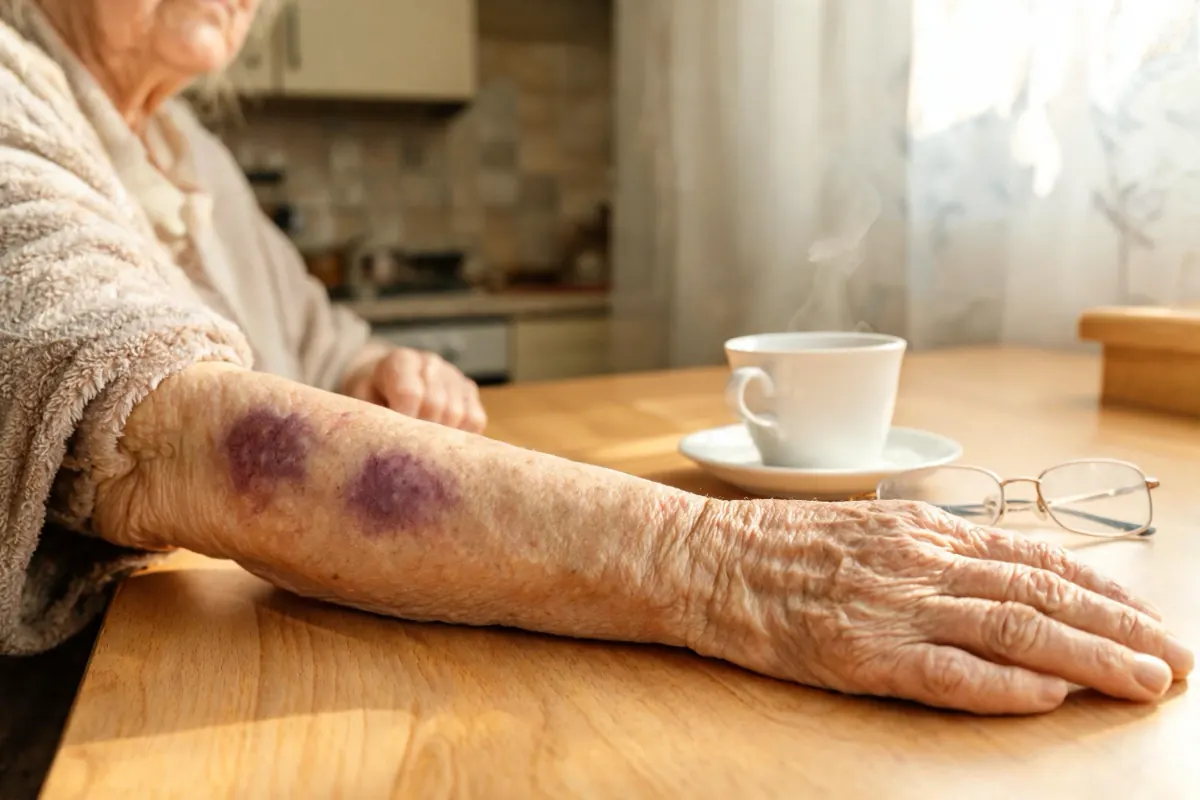
Flat, dark-purple patches with sharp edges on the outer forearms and backs of the hands, from fragile, sun-damaged skin [2]. They often appear after a sleeve rubs or someone grips your arm. Guide: senile purpura.
Medicines
Blood thinners (Eliquis, Xarelto, warfarin), aspirin, clopidogrel, steroids, NSAIDs and some antidepressants all increase bruising [3] [4]. If random bruises started after a new medicine, mention it to your doctor — but don't stop it on your own.
Thin, dry skin
Aging skin loses thickness, fat padding and moisture [8]. Dry winter skin and frequent washing make it worse.
Less common causes
Easy bruising can also come from [5]:
- low platelet count or platelet problems
- clotting disorders (inherited or acquired)
- liver disease
- vitamin C or K deficiency — vitamin C deficiency causes easy bruising and bleeding gums [7]
- rarely, blood cancers — usually with tiredness, infections or fever
See what vitamin deficiency causes bruising?
Bruises for no reason: red flags
How to find your "invisible" knocks
For one week, notice where you lean, carry or brush your arms:
- table and counter edges at forearm height
- car door frames, seatbelt buckles
- bag straps and shopping bags
- pets jumping up or claws
- grandchildren, hugs, helping someone up
- blood pressure cuffs, blood draws
Padding a few hotspots often makes a visible difference.
Arms vs other areas
Random bruises on the arms are the most common and usually least concerning, because forearms get bumped constantly and are the most sun-damaged area. Random bruises on the legs are also common, mostly on the shins. Bruises "for no reason" on the trunk, back, face, neck or inner thighs are much less typical of everyday knocks and deserve a closer look. Location is one of the most useful clues you can give your doctor.
What helps
- Moisturize arms twice a day — the same routine cut skin tears by almost half in older adults [9].
- Light long sleeves for chores.
- Sunscreen on forearms and hands.
- Medication and supplement review with your doctor or pharmacist.
- Bruise diary for two weeks before your appointment.
Frequently asked questions
Why am I suddenly getting random bruises on my arms?
Common reasons are a new medicine (especially blood thinners or steroids), drier skin, more sun damage or more knocks. If it's sudden and comes with other symptoms, see a doctor.
Is it normal to get bruises for no reason?
On the arms and legs of older adults, yes — usually from unnoticed minor knocks. Bruises in unusual places or with other symptoms should be checked.
What illness causes unexplained bruising?
Conditions that lower platelets, affect clotting or the liver, vitamin deficiencies and, rarely, blood cancers. A blood test can rule out most of these.
Can stress cause random bruising?
Stress doesn't directly cause bruises. It can lead to poorer sleep, diet and more accidental knocks, and may lead to more use of pain relievers that increase bruising.
Sources
- Mosqueda L, Burnight K, Liao S The life cycle of bruises in older adults. Journal of the American Geriatrics Society, 2005. PubMed 16078959
- Senile purpura — DermNet (New Zealand).
- Blood Thinners — MedlinePlus (U.S. National Library of Medicine).
- Prednisone — Drug Information — MedlinePlus.
- Ballas M, Kraut EH Bleeding and bruising: a diagnostic work-up. American Family Physician, 2008. PubMed 18481559
- Bleeding into the skin — MedlinePlus Medical Encyclopedia (U.S. National Library of Medicine).
- Vitamin C — MedlinePlus Medical Encyclopedia.
- Aging changes in skin — MedlinePlus Medical Encyclopedia.
- Carville K, et al. The effectiveness of a twice-daily skin-moisturising regimen for reducing the incidence of skin tears. International Wound Journal, 2014. PubMed 25040325
General information, not medical advice. Written by the Reunoa editorial team; Reunoa makes Bruise Defense & Repair Serum. See our editorial policy for how we pick sources and keep product mentions fair.