Thin skin on the backs of your hands: causes and what helps
 By Margaret Hale, Reunoa EditorialLast updated
The short answer
Thin skin on the backs of the hands comes from a lifetime of daily sun, frequent hand washing that strips oils, little fat padding over bones and tendons, and natural aging. It bruises, tears and dries easily. Moisturize after every wash, use sunscreen on your hands every morning, wear gloves for chores, and consider a retinoid at night if tolerated.
Key takeaways
- Hands get more lifetime sun than almost any other skin [1].
- Washing strips oils and dries already thin skin [2].
- Daily sunscreen slowed skin aging over 4.5 years [3].
- Retinol increased procollagen in aged skin in a 24-week trial [4].
- Twice-daily moisturizing cut skin tears by almost half in older adults [5].
On this page
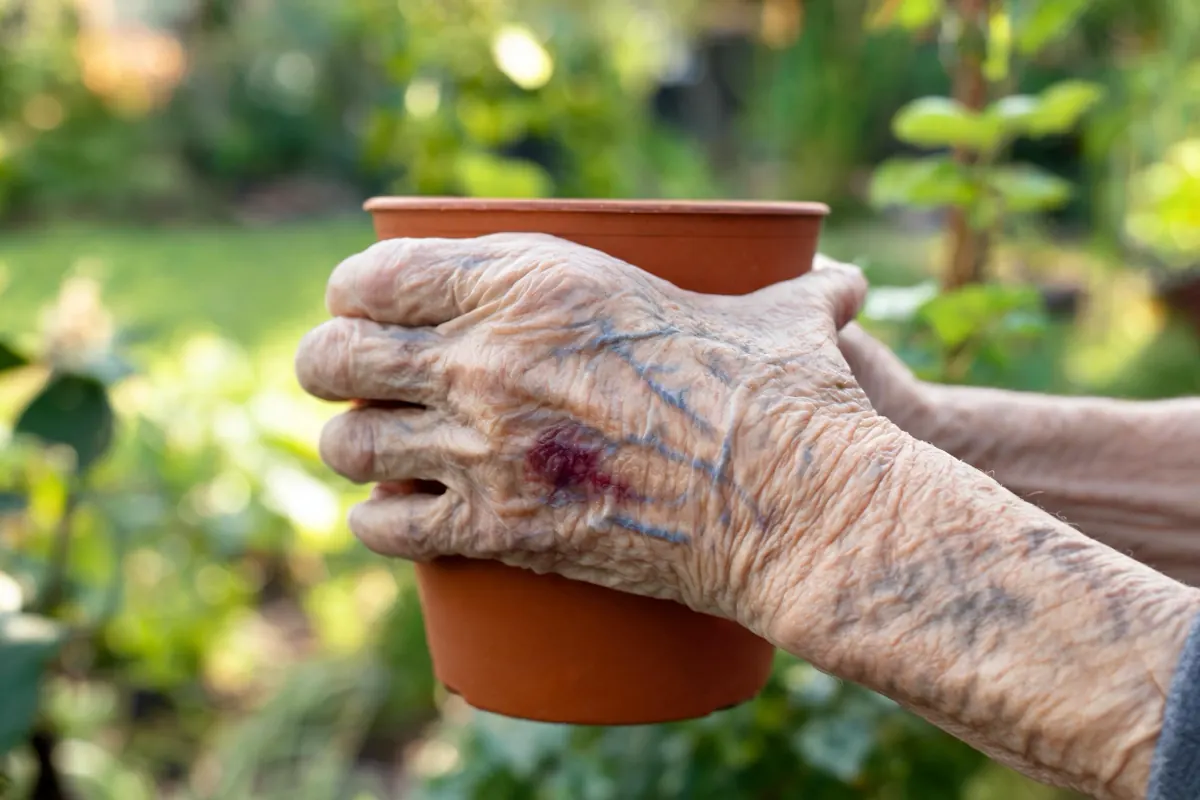
People often notice their hands aging before their face. Veins look more prominent, skin crinkles when you pinch it, and a small knock leaves a purple patch.
Why hand skin thins
- Sun: hands are exposed while driving, walking and gardening — every day, for decades. UV breaks down collagen and elastic fibres [1].
- Washing: soap and frequent washing strip natural oils, leaving skin dry and brittle [2].
- Little padding: the backs of the hands have very little fat between skin and bones or tendons.
- Aging: skin layers thin and fat padding decreases [6].
What you might notice
- translucent skin with prominent veins and tendons
- fine crinkling
- age spots
- purple patches (senile purpura on hands) [7]
- small tears from rings, bag handles, pets or tape
How to protect and strengthen hand skin
Moisturize after washing
Keep a pump bottle by every sink. Pat hands dry, then apply a fragrance-free cream. Twice-daily moisturizing of the limbs cut skin tears by almost half in aged-care residents [5]. Hands may need it more often.
Sunscreen every morning
Apply broad-spectrum SPF 30+ to the backs of your hands, and reapply after washing if you're outdoors. Daily sunscreen slowed skin aging in a 4.5-year trial [3].
A retinoid at night
Retinol increased procollagen and improved aged skin in a 24-week randomized trial [4]. Start two nights a week on the backs of the hands; build up slowly.
Gloves
Cotton-lined rubber gloves for washing up and cleaning; gardening gloves outside; soft gloves in cold, dry weather.
Small habit changes
- Lukewarm water, mild soap substitute
- Remove rings with sharp settings for chores
- Ask helpers to support your forearm, not your hand or wrist
- Avoid sticky plasters on the backs of the hands
For bruises on the hands
A wrapped cold pack right after a knock, then gentle care. High-strength (20%) arnica helped bruises fade faster than placebo in a trial [8]. More: why do my hands bruise so easily?
A simple hand routine
| When | What |
|---|---|
| Morning | Moisturizer, then sunscreen |
| After each wash | Pat dry, small amount of cream |
| Chores | Gloves |
| Evening | Retinoid (2–4 nights/week) or a richer cream; serum for bruise-prone skin |
Hand skin and everyday tasks
A few common activities cause many hand bruises and tears: carrying shopping bags with thin handles, reaching into cupboards with sharp edges, gardening without gloves, and pets jumping up. Wider padded handles, cupboard edge guards, gloves and short nails help. If you use a walker or cane, check grips for rough edges. Small changes reduce knocks noticeably.
Frequently asked questions
Why is the skin on my hands so thin?
Daily sun exposure for decades, frequent washing, little fat padding and natural aging. The backs of the hands are one of the first places skin thins.
How can I make the skin on my hands thicker?
Use a retinoid at night if tolerated, sunscreen every morning and moisturizer after washing. Results take months.
What is the best hand cream for thin skin?
A fragrance-free cream with ceramides or similar barrier lipids, used after every wash. Add a retinoid product at night if tolerated.
Why do my hands bruise so easily?
Thin, sun-damaged skin over bony areas plus frequent knocks. Blood thinners and steroids make it worse.
Do hand creams with retinol work?
Hand creams with retinol can help over months if used consistently at night. Pair them with sunscreen in the morning, as retinoids make skin more sensitive to sun.
Sources
- Rittié L, Fisher GJ Natural and sun-induced aging of human skin. Cold Spring Harbor Perspectives in Medicine, 2015. PubMed 25561721
- Dermatologists' top tips for relieving dry skin — American Academy of Dermatology.
- Hughes MC, et al. Sunscreen and prevention of skin aging: a randomized trial. Annals of Internal Medicine, 2013. PubMed 23732711
- Kafi R, et al. Improvement of naturally aged skin with vitamin A (retinol). Archives of Dermatology, 2007. PubMed 17515510
- Carville K, et al. The effectiveness of a twice-daily skin-moisturising regimen for reducing the incidence of skin tears. International Wound Journal, 2014. PubMed 25040325
- Aging changes in skin — MedlinePlus Medical Encyclopedia.
- Senile purpura — DermNet (New Zealand).
- Leu S, et al. Accelerated resolution of laser-induced bruising with topical 20% arnica: a rater-blinded randomized controlled trial. British Journal of Dermatology, 2010. PubMed 20412090
General information, not medical advice. Written by the Reunoa editorial team; Reunoa makes Bruise Defense & Repair Serum. See our editorial policy for how we pick sources and keep product mentions fair.