Hemosiderin staining on the legs: what it says about your veins
 By Margaret Hale, Reunoa EditorialLast updated
The short answer
Hemosiderin staining on the legs — rust-brown or copper patches around the ankles and shins — usually means chronic venous insufficiency: leg vein valves don't close properly, blood pools and red cells leak into the skin. It's a signal to treat the veins with compression, elevation, walking and, if needed, specialist procedures, to prevent hardened skin and ulcers.
Key takeaways
- Leg staining usually comes from venous insufficiency [1].
- Untreated, venous disease can lead to hardened skin and ulcers [2].
- Hemosiderin was always present in hardened skin and ulcers in a study of venous disease [3].
- Compression probably speeds ulcer healing, per a Cochrane review [4].
- Elevation, compression and moisturizing are standard advice for venous skin changes [5].
On this page
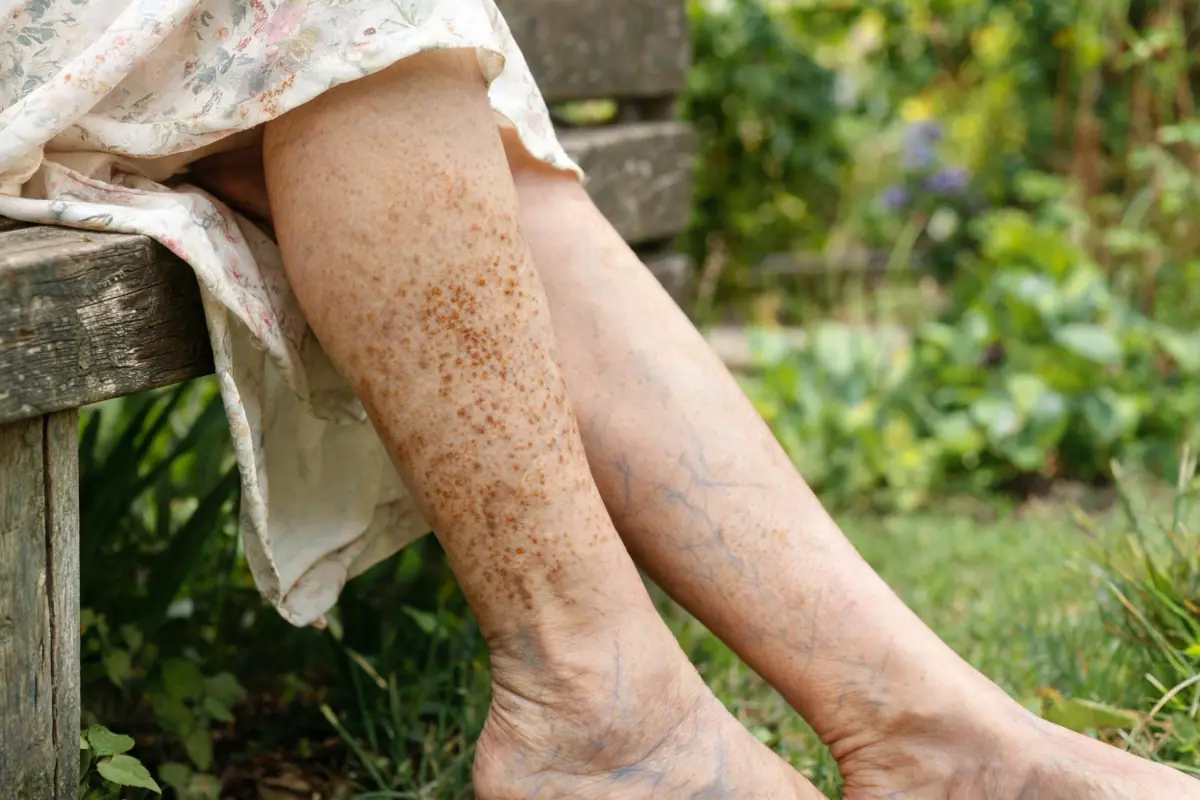
If your ankles and lower shins have gradually turned rust-brown, especially on the inner side, the cause is usually not bruising but your veins.
How it happens
Leg veins have one-way valves that keep blood moving up toward the heart. With age, pregnancies, weight, standing jobs or past blood clots, valves can weaken. Blood pools in the lower legs, pressure rises, and red blood cells are pushed out of tiny vessels into the skin [1]. As they break down, their iron stays behind as hemosiderin.
What it looks like
- Rust, copper or brown freckles and patches, often starting at the inner ankle
- Spreading up the shin over months to years
- Often with swollen ankles at day's end, aching or heavy legs, varicose veins
- Sometimes itchy, scaly, red skin (venous or stasis eczema) [5]
How it can progress
MedlinePlus describes how skin in venous disease may first look thin and slowly turn brown, and over time can become hard and develop open sores (ulcers) [2]:
| Stage | What you see |
|---|---|
| Early | Swelling, spider or varicose veins |
| Staining | Brown hemosiderin patches around ankles |
| Eczema | Itchy, red, scaly skin |
| Lipodermatosclerosis | Hard, tight, shrinking skin around the ankle |
| Ulcer | Open sore that heals slowly |
In a study of skin samples, hemosiderin was always present in hardened skin and ulcers, but not in milder stages [3].
Who is most at risk
Venous insufficiency becomes more common with age and is more likely with:
- a family history of varicose veins
- several pregnancies
- excess weight
- jobs or habits with long periods of standing or sitting
- a past deep vein thrombosis (blood clot in the leg)
- limited mobility, which weakens the calf muscle pump
Hemosiderin staining vs other leg discoloration
| Discoloration | Clues |
|---|---|
| Hemosiderin staining | Rust-brown, inner ankle and shin, with swelling or varicose veins [1] |
| Bruises | Purple, then green and yellow; fade in weeks |
| Venous eczema | Red, itchy, scaly, often on top of brown staining [5] |
| Diabetic shin spots | Small, round, light-brown scars on the shins |
| Cellulitis | Red, hot, painful, spreading, often with fever — urgent |
Treatment
- Compression stockings — the cornerstone. A Cochrane review found people with venous leg ulcers probably heal faster with compression [4]. Get properly measured; ask your doctor which strength suits you (compression isn't suitable for everyone, e.g. with poor arterial circulation).
- Elevation — legs above heart level for 30 minutes, three or four times a day [5].
- Walk daily — calf muscles pump blood upward.
- Moisturize — dry, itchy skin on the shins cracks easily; fragrance-free emollients help [7].
- Vein assessment — a vein specialist can check with ultrasound and discuss procedures.
- Lasers for the pigment — once veins are treated, lasers may lighten stains; in one small study 45% of stains lightened with pulsed dye laser [6].
Frequently asked questions
What causes hemosiderin staining on the lower legs?
Usually chronic venous insufficiency: weak vein valves let blood pool, and red cells leak into the skin, leaving iron-based brown pigment.
Is hemosiderin staining on legs serious?
The pigment isn't, but it often signals vein disease that can progress to hardened skin and ulcers. It's worth a doctor's assessment.
Do compression socks help hemosiderin staining?
They treat the underlying vein problem and can stop the staining from getting worse. Existing pigment fades slowly, if at all.
Can hemosiderin staining on legs be removed?
Treating the veins comes first. Lasers may then lighten remaining stains, with partial results.
Does hemosiderin staining on legs mean I have a blood clot?
Not usually. Staining develops slowly over months or years from vein valve problems. A blood clot causes sudden swelling, warmth and pain in one leg — that needs same-day medical care.
Can exercise help hemosiderin staining on the legs?
Walking and ankle exercises activate the calf muscle pump, which helps move blood out of the lower legs. Combined with compression and elevation, regular walking supports vein health and can slow further staining.
Sources
- Venous insufficiency — MedlinePlus Medical Encyclopedia.
- Stasis dermatitis and ulcers — MedlinePlus Medical Encyclopedia.
- Caggiati A, et al. Skin iron deposition characterises lipodermatosclerosis and leg ulcer. European Journal of Vascular and Endovascular Surgery, 2010. PubMed 20880725
- Shi C, et al. Compression bandages or stockings versus no compression for treating venous leg ulcers. Cochrane Database of Systematic Reviews, 2021. PubMed 34308565
- Venous eczema — DermNet (New Zealand).
- Goldman MP Postsclerotherapy hyperpigmentation. Treatment with a flashlamp-excited pulsed dye laser. Journal of Dermatologic Surgery and Oncology, 1992. PubMed 1607465
- Dermatologists' top tips for relieving dry skin — American Academy of Dermatology.
General information, not medical advice. Written by the Reunoa editorial team; Reunoa makes Bruise Defense & Repair Serum. See our editorial policy for how we pick sources and keep product mentions fair.