Hemosiderin staining treatment: what actually works on brown stains
 By Margaret Hale, Reunoa EditorialLast updated
The short answer
The most effective hemosiderin staining treatment is stopping new bleeding into the skin: protecting fragile forearms from knocks, and treating vein problems in the legs with compression, elevation and, where suitable, vein procedures. Sun protection keeps stains from darkening. Lasers can lighten stubborn stains in some cases. No cream is proven to remove hemosiderin.
Key takeaways
- Hemosiderin is iron left behind from broken-down blood; repeated bleeding builds it up [1].
- Leg staining usually signals venous insufficiency, so treating the veins comes first [2] [3].
- Compression probably helps venous leg ulcers heal faster, per a Cochrane review [5].
- In a small study, 45% of post-vein-treatment stains lightened with pulsed dye laser [6]; Q-switched lasers have also been reported to help [7].
- No topical cream has been proven to remove hemosiderin.
On this page
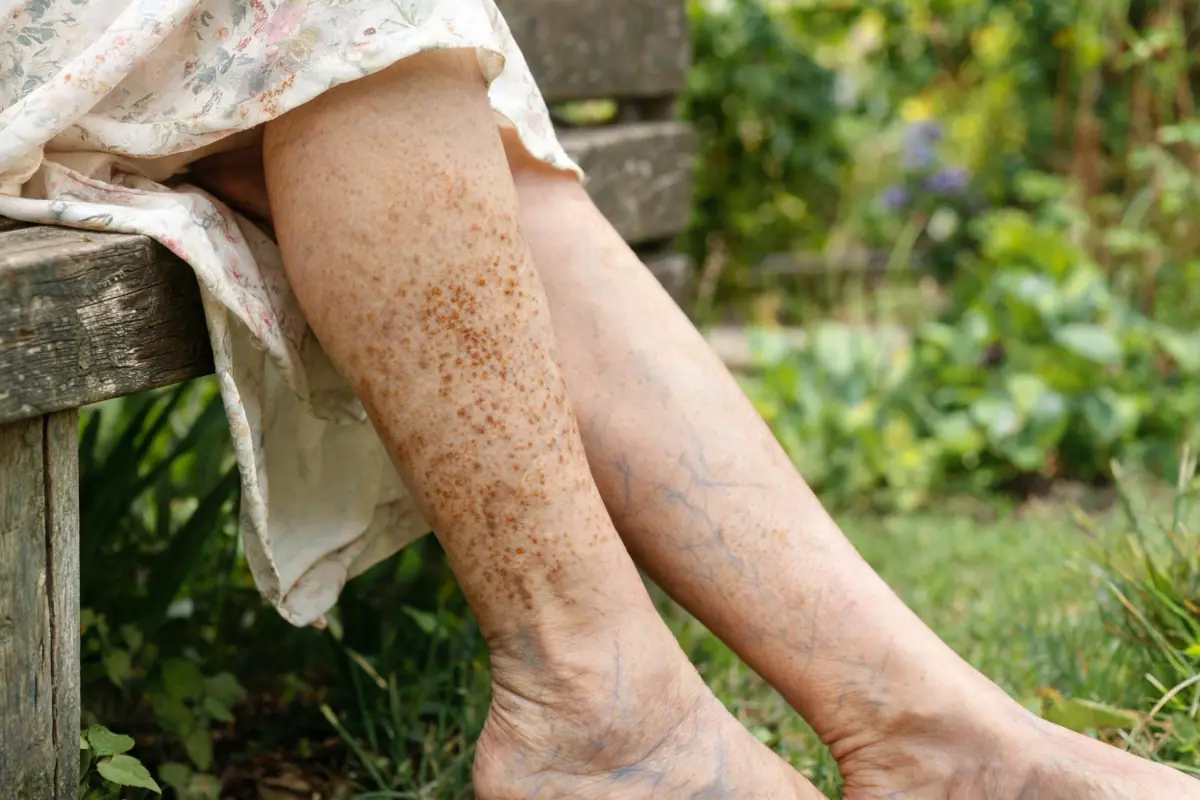
Hemosiderin staining is stubborn. The brown iron pigment sits in the dermis, deeper than ordinary sun spots, which is why bleaching creams rarely touch it. But there is a clear order of what to do, and a few treatments with real evidence.
First, know which type you have
| Forearms / hands | Lower legs / ankles | |
|---|---|---|
| Usual cause | Repeated senile purpura and bruises [1] | Venous insufficiency [2] |
| Main treatment | Stop new bruising | Treat the veins |
| Outlook | Can lighten slowly over months | Often persists unless veins are treated |
Overview: hemosiderin staining guide.
Step 1: Stop new bleeding into the skin
Every new bruise adds more iron. This is the single most important step.
Forearms: sun protection, twice-daily moisturizer (cut skin tears by almost half in older adults [10]), long sleeves for chores and padding sharp corners. Products for fragile, bruise-prone skin can reduce new purpura — see senile purpura treatment.
Legs: treat the vein problem (step 2).
Step 2: For leg staining — treat the veins
Brown staining on the lower legs is often an early sign of chronic venous insufficiency. MedlinePlus lists compression stockings, raising the legs and treating the underlying condition [3]; DermNet recommends elevation, compression and moisturizing for venous skin changes [4].
- Compression stockings — a Cochrane review found people with venous leg ulcers probably heal faster with compression [5]. For staining without ulcers, compression treats the cause.
- Elevation — legs above heart level for 30 minutes, several times a day.
- Walking — calf muscles pump blood up the veins.
- Vein procedures — a vein specialist can assess whether ablation or sclerotherapy is suitable.
A study of skin samples from people with chronic venous disease found hemosiderin always present in hardened skin (lipodermatosclerosis) and ulcers [8] — another reason not to ignore leg staining.
Step 3: Sun protection
Sun darkens pigmented marks and further thins forearm skin. Use a broad-spectrum SPF 30+ sunscreen [9].
Step 4: Lasers (for stubborn stains)
Lasers that target pigment can break down hemosiderin:
- Pulsed dye laser: in a small study of long-standing stains after vein treatment, 45% lightened and 27% lightened significantly [6].
- Q-switched lasers: a 2015 case report described successful lightening of hemosiderin hyperpigmentation with a Q-switched 755-nm laser [7].
Evidence is limited to small studies; results are partial, multiple sessions are often needed, and cost is usually not covered by insurance. Ask a dermatologist experienced with pigment lasers.
What about creams?
No topical product has been proven to remove hemosiderin. Hydroquinone and other bleaching agents target melanin, not iron, and can irritate thin skin. Topical products for bruise-prone skin may help indirectly by reducing new bleeding into the skin.
What not to do
- Don't use harsh scrubs or strong peels on thin skin
- Don't stop blood thinners to reduce staining
- Don't ignore leg staining with swelling, hardening or sores
Frequently asked questions
What is the best treatment for hemosiderin staining?
Stop new bleeding into the skin first. For legs, treat the vein problem with compression, elevation and specialist care. Lasers can lighten stubborn stains in some cases.
Can hemosiderin staining be removed?
Sometimes partially. Lasers have lightened stains in small studies. Light staining may fade on its own if new bleeding stops.
Do creams work for hemosiderin staining?
No cream has been proven to remove hemosiderin. Bleaching creams target melanin, not iron. Products that reduce new bruising may help indirectly.
Does compression help hemosiderin staining?
Compression treats the vein problem behind leg staining, which can stop it from getting worse. It doesn't remove existing pigment directly.
Sources
- Senile purpura — DermNet (New Zealand).
- Venous insufficiency — MedlinePlus Medical Encyclopedia.
- Stasis dermatitis and ulcers — MedlinePlus Medical Encyclopedia.
- Venous eczema — DermNet (New Zealand).
- Shi C, et al. Compression bandages or stockings versus no compression for treating venous leg ulcers. Cochrane Database of Systematic Reviews, 2021. PubMed 34308565
- Goldman MP Postsclerotherapy hyperpigmentation. Treatment with a flashlamp-excited pulsed dye laser. Journal of Dermatologic Surgery and Oncology, 1992. PubMed 1607465
- Gan SD, Orringer JS Hemosiderin Hyperpigmentation: Successful Treatment With Q-Switched 755-nm Laser Therapy. Dermatologic Surgery, 2015. PubMed 26561958
- Caggiati A, et al. Skin iron deposition characterises lipodermatosclerosis and leg ulcer. European Journal of Vascular and Endovascular Surgery, 2010. PubMed 20880725
- How to select a sunscreen — American Academy of Dermatology.
- Carville K, et al. The effectiveness of a twice-daily skin-moisturising regimen for reducing the incidence of skin tears. International Wound Journal, 2014. PubMed 25040325
General information, not medical advice. Written by the Reunoa editorial team; Reunoa makes Bruise Defense & Repair Serum. See our editorial policy for how we pick sources and keep product mentions fair.