Does hemosiderin staining go away?
 By Margaret Hale, Reunoa EditorialLast updated
The short answer
Sometimes. Light hemosiderin staining after a few bruises often fades slowly over several months as the body clears the iron. Staining built up over years — from repeated senile purpura or vein disease in the legs — usually lasts much longer and can be permanent. Stopping new bleeding into the skin gives the best chance of fading; lasers can help some stubborn stains.
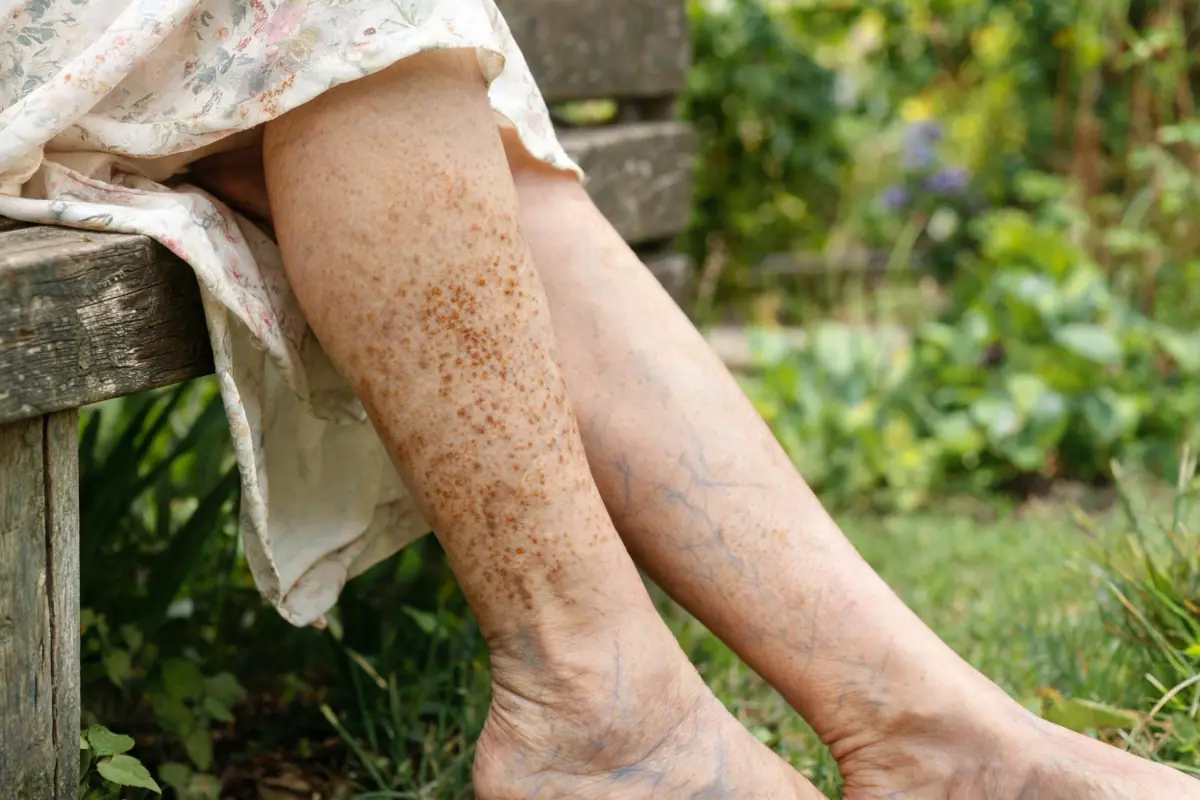
There's no single answer, because hemosiderin staining ranges from a faint brown shadow after one bruise to a deep bronze tint built up over a decade. Here is what decides whether it fades.
What decides the outcome
| Factor | Better chance of fading | Lower chance of fading |
|---|---|---|
| Amount of past bleeding | One or a few bruises | Years of repeated bruises |
| Ongoing bleeding | Stopped | Continuing |
| Location | Forearms, hands | Lower legs with vein disease [2] |
| Circulation | Good | Poor venous return |
| Sun | Protected | Regular sun exposure |
Forearms and hands
DermNet notes senile purpura patches resolve over one to three weeks and may leave residual brown pigmentation [1]. If new patches become less frequent, light staining often fades over months. Where purpura keeps recurring, the brown builds up and can become a lasting tint.
Lower legs
Leg staining from venous insufficiency usually persists while the vein problem continues, because pressure keeps pushing red cells into the skin [2]. Compression, elevation and treating the veins can stop it from getting worse [3], and some lightening can occur over time.
Speeding it up
- Stop new bleeding: protect forearms, moisturize twice daily (cut skin tears by almost half in older adults [6]), wear sleeves.
- Treat leg veins: compression stockings, elevation, vein specialist.
- Sun protection to stop darkening.
- Lasers: in a small study, 45% of long-standing stains lightened with pulsed dye laser [4]; Q-switched lasers have also been reported to work in individual cases [5].
Full options: hemosiderin staining treatment.
Realistic timeline
- After a single bruise: often weeks to a few months
- After repeated forearm purpura, if new patches drop: several months to a year or more
- Leg staining with untreated vein disease: often permanent; can darken
Why some stains outlast others
Hemosiderin sits in the dermis, the deeper layer of skin, inside cleanup cells called macrophages. The body removes it very slowly, and there is no fast "flush". On the forearms, the main driver is how often new purpura patches appear in the same place. On the legs, it's whether the veins keep pushing red cells into the skin. That's why two people with similar-looking stains can have very different outcomes: one who reduces new bleeding often sees gradual lightening; one with ongoing leakage sees the stain deepen.
Tracking progress
Take a photo in the same daylight once a month, with a coin for scale. Changes are slow and easy to miss day to day. Many people notice lightening only when they compare photos taken three to six months apart.
Frequently asked questions
How long does hemosiderin staining last?
From weeks after a single bruise to years or permanently after repeated bleeding or with vein disease.
Can hemosiderin staining be reversed?
Partly. Stopping new bleeding lets the body slowly clear iron. Lasers can lighten stubborn stains in some cases.
Why won't the brown mark from my bruise go away?
Iron left behind as hemosiderin clears slowly, especially in older, sun-damaged skin or where bruising keeps recurring.
Does vitamin C cream help hemosiderin?
There's no good evidence that vitamin C cream removes hemosiderin. It may help general skin tone and collagen.
Sources
- Senile purpura — DermNet (New Zealand).
- Venous insufficiency — MedlinePlus Medical Encyclopedia.
- Stasis dermatitis and ulcers — MedlinePlus Medical Encyclopedia.
- Goldman MP Postsclerotherapy hyperpigmentation. Treatment with a flashlamp-excited pulsed dye laser. Journal of Dermatologic Surgery and Oncology, 1992. PubMed 1607465
- Gan SD, Orringer JS Hemosiderin Hyperpigmentation: Successful Treatment With Q-Switched 755-nm Laser Therapy. Dermatologic Surgery, 2015. PubMed 26561958
- Carville K, et al. The effectiveness of a twice-daily skin-moisturising regimen for reducing the incidence of skin tears. International Wound Journal, 2014. PubMed 25040325
General information, not medical advice. Written by the Reunoa editorial team; Reunoa makes Bruise Defense & Repair Serum. See our editorial policy for how we pick sources and keep product mentions fair.