Is hemosiderin staining dangerous?
 By Margaret Hale, Reunoa EditorialLast updated
The short answer
The brown pigment in hemosiderin staining is not dangerous itself. On the forearms, after senile purpura, it's a harmless cosmetic after-effect. On the lower legs, it often signals chronic venous insufficiency — and without treatment, that can progress to hardened skin and leg ulcers. Leg staining, especially with swelling or itching, should be checked by a doctor.
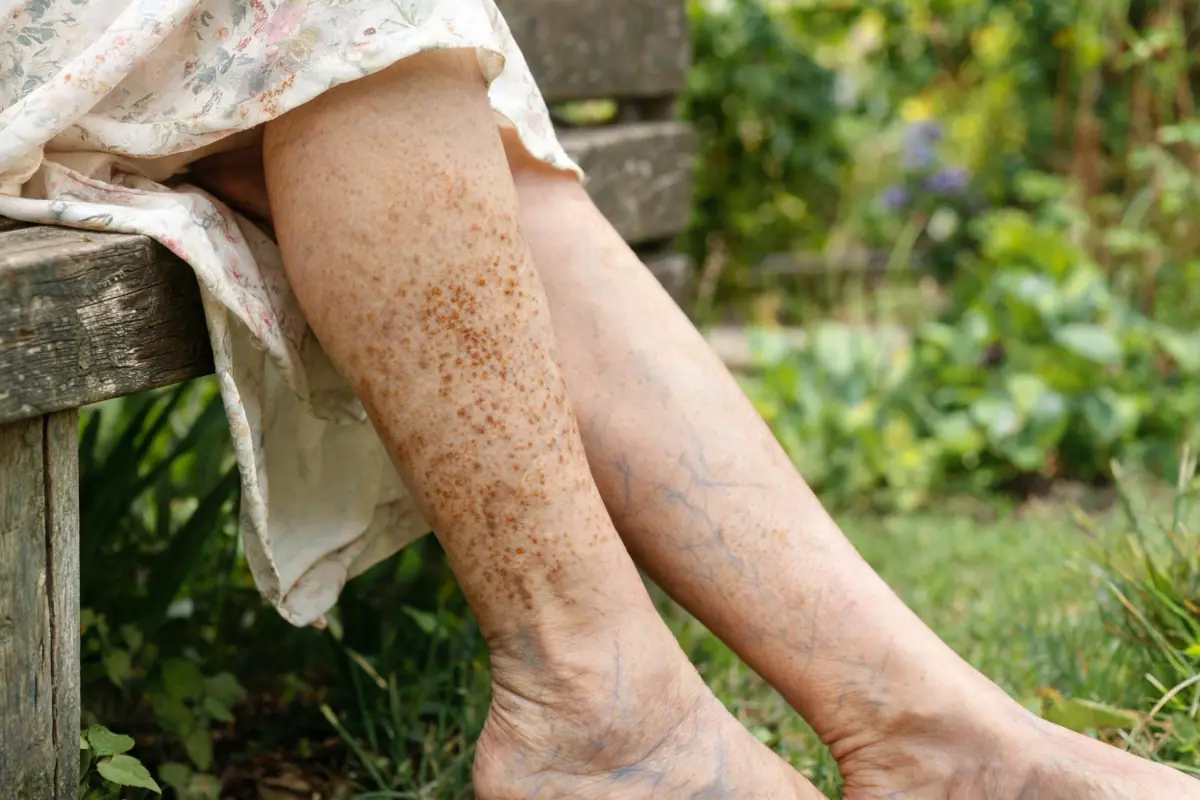
Brown staining on the skin can look alarming. Whether it matters depends almost entirely on where it is and what's causing it.
On the forearms and hands: harmless
When senile purpura patches fade, iron from the leaked blood is often left behind as hemosiderin, creating brown pigmentation [1]. It's a cosmetic issue that shows the skin is fragile — not a health risk.
On the lower legs: a warning sign
Brown staining around the ankles and shins usually comes from chronic venous insufficiency: leg vein valves don't close well, blood pools, and pressure pushes red blood cells into the skin [2]. MedlinePlus describes how lower-leg skin in venous disease can thin, turn brown and, over time, become hard and develop sores [3].
A study of skin samples from people with chronic venous disease found hemosiderin always present in hardened skin (lipodermatosclerosis) and in ulcers [4]. That doesn't mean every brown stain becomes an ulcer — but it shows staining is part of a progression worth stopping early.
Signs it's progressing
Why vein disease matters beyond the skin
Chronic venous insufficiency is common with age and often starts quietly: ankles that swell by evening, legs that feel heavy after standing, a few varicose veins. Brown staining is one of the first visible skin signs that pressure in the leg veins has been high for a long time [2]. At that stage, simple measures — compression, elevation, walking, keeping the skin moisturized — can slow things down. Once the skin hardens or an ulcer opens, healing takes much longer.
That's why we encourage anyone with new brown staining on the lower legs to mention it at their next appointment, even if it doesn't hurt.
Questions to ask your doctor
- Is this staining from my veins, or something else?
- Should I have an ultrasound of my leg veins?
- Which compression stockings, and what strength, are right for me?
- Is my arterial circulation good enough for compression?
- What should I do if the skin gets itchy, red or a sore appears?
What to do
| Location | Action |
|---|---|
| Forearms, after purpura | Protect skin from knocks and sun; see treatment |
| Lower legs | See a doctor; compression, elevation, vein assessment |
| Anywhere, changing spot | Dermatologist check |
Frequently asked questions
Is hemosiderin staining a sign of poor circulation?
On the lower legs, often yes — specifically, poor return of blood through the veins (venous insufficiency). On the forearms, it usually follows repeated bruising instead.
Can hemosiderin staining lead to ulcers?
The pigment itself doesn't, but the vein disease behind leg staining can progress to hardened skin and ulcers if untreated.
Is hemosiderin staining permanent?
It can be, especially on the legs with ongoing vein disease. Forearm staining often lightens slowly if new bruising is reduced.
Is hemosiderin staining the same as age spots?
No. Age spots are melanin from sun exposure and are usually flat, tan and well defined. Hemosiderin is iron from blood, rust-brown, and follows bruising or vein problems.
Sources
- Senile purpura — DermNet (New Zealand).
- Venous insufficiency — MedlinePlus Medical Encyclopedia.
- Stasis dermatitis and ulcers — MedlinePlus Medical Encyclopedia.
- Caggiati A, et al. Skin iron deposition characterises lipodermatosclerosis and leg ulcer. European Journal of Vascular and Endovascular Surgery, 2010. PubMed 20880725
- Venous eczema — DermNet (New Zealand).
General information, not medical advice. Written by the Reunoa editorial team; Reunoa makes Bruise Defense & Repair Serum. See our editorial policy for how we pick sources and keep product mentions fair.